

I may have achieved enlightenment at an indoor play gym last weekend.
You know the kind – where every surface is sticky, padded, and kids still find a way to injure themselves.
My 5-year-old is chasing “Purple Girl” around at light speed – in socks.
My 3-year-old launches himself down a slide headfirst into another child climbing up the same slide.
The 1-year-old is crying on my shoulder, drool pooling on my Yankees shirt.
And everywhere, there is screaming.
My brain’s running its usual program: irritation about the noise, deliverables piling up, parental guilt for checking baseball score while my kids play. The knot in my chest—that familiar tightness that comes from trying to control everything while controlling nothing—pulls tighter.
Purple Girl walks up to me and says, “Your son (the 5-year-old) pushed us down the slide.” My 1-year-old is screaming at the top of another slide because he has no one to ride down with him. My 3-year-old is holding on to my ankle, yelling, “Daddy, I want you to walk!” Michelle is in San Antonio – blissfully ignorant.
“Siri, define overstimulation.”
And, thanks to Eckhart Tolle’s The Power of Now, it is in this moment that I access inner peace.
THE POWER OF NOW: A GUIDE TO SPIRITUAL ENLIGHTENMENT
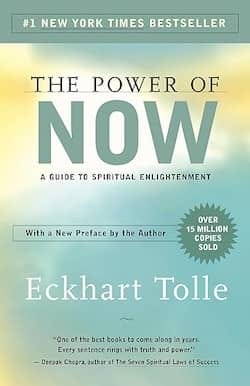
Author: Eckhart Tolle
Published: 1997
Length: 256 pages
Buy: https://amzn.to/46PHcvu
WHY THIS BOOK MATTERS
Most spiritual books promise you’ll find peace once you meditate enough, forgive enough, or finally let go of your ego. Tolle’s different. He says you can access that peace right now – even when you’re holding a screaming toddler while your other kids are weaponizing slides.
I read this book over a decade ago after it was recommended by my good friend Nic, a man living a parallel life to mine but a few miles ahead on the path.
When he recommended Tolle while standing in a take-out line to bring dinner back to his family, I was in a pretty dark place. I was still grieving my mother’s death without the emotional tools to do so correctly.
Over the years, I had also been moving away from Catholicism. It wasn’t so much a firm decision as a drift. After Mom’s passing, it had accelerated to a brisk walk. I had a tough time reconciling how my mom, a generally fantastic person, could get “called home” early after 58 years of being good. Meanwhile, I was left here to continue my sprint on the hedonic treadmill, hearing “You’re such an asshole” with regularity and smiling because I knew it to be true.
It was a good time to look at my life from a different angle.
Enter Tolle. He was 29, on the verge of suicide, when he was “awakened.” And his advice feels like it. A guy fed up with the mechanics of life who found a gateway into something better, then made it his life’s work to share the map.
I like my wisdom digestible and accessible. In that moment, in the state I was in, it was mana in the desert.
Tolle wasn’t telling me to fix my situation. He was pointing out that my suffering wasn’t coming from the situation – it was coming from my resistance to it.
That distinction changes everything.
Fast forward to the screaming and leg-pulling.
A new stage of life. A new drift – a season of transformation and burning of old things to make way for new things. An inkling two weeks prior that this should be the next book I write about.
And, in true Outlast Yourself fashion, it held up.
It served me differently this time around, as I am not the same man I was when I last stepped into this literary river. But it reminded me of something important:
Sometimes – often – my only job in life is to accept what “is.”
THE ESSENTIALS: 3 CORE IDEAS
1. The Pain Body
Tolle has a term for what most of us carry without realizing it: the pain-body.
It’s the accumulated emotional pain living in your nervous system. Every layoff. Every time you felt powerless. Every moment you chose security over growth and resented yourself for it. That pain doesn’t disappear. It stacks up. It waits.
The pain-body feeds on situations that create more pain. It magnifies minor irritations into major disruptions. Your kid asking for snacks becomes evidence that your life is chaos. Your wife’s question about dinner becomes an indictment of your worth as a provider.
You’re not reacting to what’s happening. You’re reacting to everything that’s ever happened, all at once.
This is why you snap at your kids when they’re just being kids. Why Sunday nights feel like dread even when Monday looks manageable. Why you can’t just enjoy the play gym – you have to control it, because chaos feels like a threat to your already-fragile sense that you’re holding everything together.
Tolle says the first step isn’t to fix it. It’s to see it. To catch yourself and realize: “This reaction is way bigger than this trigger.”
That awareness creates a gap. And in that gap, you have a choice you didn’t have before.

2. Becoming Transparent
Tolle uses the relatable example of a car alarm to highlight this. It’s a peaceful night, and a car alarm goes off. It chirps for the requisite amount of time. So you sit there. With each bray, more frustration floods into your body and hits a wall. It stays with you. Your pain body feasts like a stoner on a couch, watching Rick and Morty, Double Stuf Oreos disappearing at record speed. (I don’t know anyone who does this).
And all of a sudden, you’re fucking angry. And you stay angry, even when that asshole finds the keys and the soothing double-beep signals that the whole misery is over.
But what if you had a veil instead of a wall? Something transparent, lightweight, a linen sheet in a breeze? What if you could let the noise pass through you instead of resisting it? Feel it, then release it.
That’s what I did at the play gym.
I let everything pass through me – Purple Girl’s complaints, one kid’s sad screams, the other kid’s laughing screams. I just…was.
What changed about my external state? Nothing.
How did I feel? Like someone removed a 1.5 pood kettlebell from my chest.
3. Everything You’re Clinging to is Already Gone
Twelve years ago, this was a jarring thought for a faithless kid who was wrestling with loss and mortality.
During my recent re-read, it was also jarring – for very different reasons.
At the book’s core, Tolle is teaching impermanence. Everything changes, disappears, or stops satisfying you. Your job title, your salary, your professional identity. But also: the father who tries not to miss tee-ball, the provider and protector, the husband who keeps trying to figure out how he’s supposed to talk to his wife.
On a long enough timeline, they all disappear. You retire. The work keeps going. Your kids are off to college. Tee ball is still going on at the park. If you’re fortunate, your marriage is intact. (I saw first-hand what it’s like when it’s not, and that’s a whole different experience).
And then, it all fades away. Because you fade. So will I. So will everyone telling you they love you—along with everyone telling you they hate you, or don’t believe in you, or wish you could be a little more emotionally intelligent when you bring up certain topics
Time is undefeated.
And there’s something about that knowledge that, while scary, is truly liberating.
When you stop clinging to those identities – when you accept they’re temporary anyway – you can actually be present. Not the perfect provider or the perfectly present dad. Just… there. Actually available instead of mentally elsewhere.
Once I accept that old Mike is dead, current Mike will be gone, and future Mike will eventually be dust too, a certain clarity comes.
Nothing matters except the stuff I choose to let matter. And even then, it only matters to me while I (and the people I care about) are here.
That awareness is an ally. It gives you permission to let go of all of it – your past grievances, your expectations, your chubby fuck of a pain body.
And just be.
THE ENDURANCE FACTOR
This book will outlast your current crisis because it’s not about your current crisis.
Twenty-seven years after publication, people are still discovering Tolle during their own personal apocalypses – the layoff, the divorce, the diagnosis, the moment when the life they built stops fitting. Each generation thinks they’re the first to realize that clinging to temporary identities creates suffering.
We’re not.
The Stoics knew it. The Buddhists knew it. Tolle just translated it for people who won’t sit on meditation cushions but will read a book on a Delta flight while their old life burns down behind them.
Your current transition will resolve one way or another. You’ll find your next thing or you won’t. Your kids will grow up either way. But the question Tolle poses remains: Will you spend your limited time here clinging to identities that are already dying, or will you actually show up for the life you have right now?
That question doesn’t age. Neither does the answer.
KEY QUOTES
The pain-body doesn’t want you to observe it directly and see it for what it is. The moment you observe it, feel its energy field within you, and take your attention into it, the identification is broken.
My anger at the play gym wasn’t about Purple Girl or the screaming kids. It was every accumulated disappointment trying to stay alive by feeding on chaos. The second I caught myself – “wait, this reaction is way too big” – the spell broke. That’s the whole game. Just see it.
Instead of having a wall of resistance inside you that gets constantly and painfully hit by things that ‘should not be happening,’ let everything pass through you.
Most of your suffering comes from three words: “This shouldn’t be.” You shouldn’t have to reduce your team. The job search shouldn’t take this long. Your kids shouldn’t melt down at bedtime. Delete “shouldn’t” from your vocabulary and half your problems disappear.
Nothing lasts in this dimension where moth and rust consume.
Your VP title? Gone. Your current crisis? Temporary. Your kids’ tee-ball phase? Blink and you’ll miss it. Everything you’re desperately trying to control is already slipping through your fingers. So maybe just show up for it while it’s here.