

People don’t change because they prefer the devil they know.
It’s seductively easy to stay where you are. Our problems become familiar, almost comfortable enemies.
They’re predictable. They justify your inaction. And let’s face it, they give you something to blame.
You don’t move forward because staying stuck requires less effort than facing uncertainty head-on.
Don’t bullshit yourself: you know exactly what you’re supposed to do.
You want something in your life to change. You know what’s holding you up. The quiet voice inside is telling you—with annoying precision—what needs to be done.
And yet, you don’t do it.
Why?
It’s not ignorance. It’s not laziness—though procrastination is usually a sign you’re avoiding an obstacle. It’s something more primal.
Fear.
The pain of change—even positive change—feels sharper than the dull ache of mediocrity. The ache that sends us hurtling towards dopamine dead-ends: drinking, doom-scrolling, drugs, or just sitting on your Vuori-sweatpant-clad ass, mindlessly munching couch snacks while re-watching The Wire...again.
I do it way more than someone writing about the topic should admit in public.
But I’m writing precisely because of what I learned in this book. And if you’re stuck—and let’s be honest, you’re stuck somewhere—this is the mental reframe you need.
THE OBSTACLE IS THE WAY: THE TIMELESS ART OF TURNING TRIALS INTO TRIUMPHS
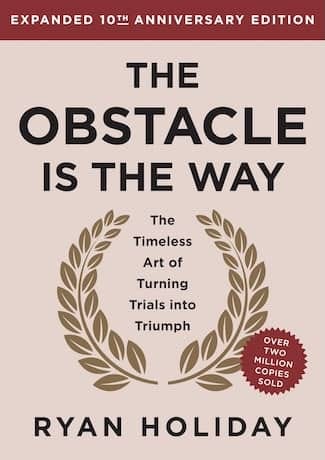
Author: Ryan Holiday
Published: May 1, 2014
Length: 224 pages
Buy It Here: https://amzn.to/3MzurOB
WHY THIS BOOK MATTERS
The impediment to action advances action. What stands in the way becomes the way. — Marcus Aurelius
This is where my man-crush on the philosopher king became serious.
Marcus Aurelius was the last of the five Good Roman Emperors—one of the most powerful men in the world at the time. A man with more power than any of us can fathom took the time to sit down, reflect on his thoughts, and keep a personal journal. Not for an audience. Not for publication. Just for himself, to himself.
What he wrote is one of history’s most effective formulas for overcoming damn near every negative situation we encounter in life. A formula for thriving not just in spite of whatever happens, but because of it.
The Obstacle Is The Way is a smooth entrance to Stoic philosophy—principles as practical today as they were two thousand years ago.
These days, Stoic ideas are everywhere - successful leaders read them, YouTube pages are dedicated to them, and you can’t scroll a social feed without hitting a Stoic quote (I’ve done my part to add to the pile). But a decade ago, it was Ryan Holiday who was introducing us to the OG Stoics like Marcus Aurelius, Epictetus, and Seneca.
He also highlighted more recent figures like Teddy Roosevelt, Thomas Edison, and Steve Jobs—people who practiced Stoic principles, whether they called themselves Stoics or not.
This book isn’t really about the obstacles themselves. It’s about how we respond to them.
Greatness doesn’t come from avoiding difficulty. It comes from facing it—with clarity, courage, and composure.
The foundation is psychological: conditioning your mind to see adversity not as a threat, but as fuel.
THE ESSENTIALS: 3 CORE IDEAS
𝟭. Perception: The Obstacle Isn’t What You Think It Is
Holiday opens with perception because it’s the foundation. How you see an obstacle determines everything that follows.
Rubin “Hurricane” Carter spent nearly 20 years in prison for a crime he didn’t commit. He could’ve let the rage eat him alive. Instead, he turned his cell into a classroom—reading, studying, becoming someone the system never intended him to be.
Same situation. Different lens. Completely different outcome.
I’ve had my share of moments that felt like disasters at the time. Jobs where the promise and the reality were miles apart. Projects that flopped in public (which feels awesome, lemme tell you). Circumstances that felt catastrophic—like the universe was taking a deep drag on a cigarette and blowing the smoke into my open eyes.
And in those moments, I did what most people do: I blamed everything external. The owner who changed direction. The market that was hostile. The bad luck, the bad timing, the bad everything.
But once I stopped seeing those situations as things that happened 𝘵𝘰 me and started seeing them as things that just happened—and then asked “okay, what can I use here?”—everything shifted.
It wasn’t overnight. There wasn’t a 3-minute montage cut to a song you’ll Shazam in the theatre. Just a slow, ugly crawl from “why me?” to “what now?”
Most people never get past the emotional reaction. They camp out in “this is terrible” and never make it to “this is what’s happening—so now, what’s my move?”
That reframe is everything.
It’s also exhausting. There’s plenty of situations where my knee-jerk reaction is to blame the circumstances. But I’ve seen what happens when I stay parked in that mindset.
And it’s way fucking worse.
2. Action: Do Something, Even If It’s Small
After perception comes action. Because, surprise surprise, if you don’t take action, you stay exactly where you are.
Edison failed over 10,000 times before the light bulb worked. Teddy Roosevelt said it best: “We must all either wear out or rust out. My choice is to wear out.”
Nobody tells you this when you’re starting something, but taking action doesn’t feel like momentum at first. It feels like flailing by yourself in a dark ocean miles from shore. Like you’re the only idiot doing it wrong. Like everyone else who’s been successful got ahold of the manual, but you’re the sucker who’s stuck making it up as you go.
But that’s because you ARE making it up as you go. It’s only through trial and error that you figure anything out. The only way to ensure you don’t make progress is to spend another day ‘optimizing your plan’ instead of getting in the fucking ring and taking some hits.
When I look at the things in my life that actually changed—weight loss, Spanish fluency, writing consistency—none of them started with a perfect plan or ideal conditions. I just started. I had to start to figure out what worked and what didn’t (like learning that I can’t write with the kids throwing Bluey and Bingo toys at each other). And I just didn’t stop.
Most days, it didn’t feel like progress. Honestly, it still rarely feels like progress. There’s plenty of days that feel like I’m sliding backwards, too.
But Holiday keeps hammering this point: “What is defeat? Nothing but education; nothing but the first steps to something better.”
The people who win aren’t smarter or more talented. They’re just more willing to look stupid while they figure it out. They take messy action. They iterate. They don’t wait for conditions to be perfect because they’ve accepted that conditions will never be perfect.
You already know what you need to do. You’ve known for a while.
So the question isn’t “what should I do?”
It’s “will I do it today, or keep waiting for some bullshit ‘right time’ that’s never coming?”
3. Will: Love What Happens (Even When It Sucks)
The final pillar is Will. Specifically, Amor Fati—a love of one’s fate.
This doesn’t mean pretending something shitty is good. But it does mean accepting the situation fully and finding a way forward anyway.
Marcus Aurelius dealt with betrayal, plague, and war. He couldn’t control any of it. But he could control his response. “The Fates guide the person who accepts them and hinder the person who resists them.”
This was tested for me when my mom died at 56 with her bakery dream unrealized.
She was an expert baker, and her years feeding 3 teenage athletes who ate her out of house and home were her 10,000 hours. She talked about starting a bakery, but despite her family and friends encouraging her, it stayed a dream. Then she was diagnosed with a rare and aggressive uterine cancer. She was gone 10 months later, and her dreams died with her.
I couldn’t change what happened. And Holiday hadn’t written this book yet, so I didn’t have many of the tools that would have helped me handle that situation better.
Years later, I’d turn that pain into fuel.
That’s my why.
I don’t want to go out like that. I want to help others who feel something slowly dying inside—who know they have more to build, more to become, but keep putting it off for some version of “later” that never arrives. And if I keep waiting for that mythical someday, I’ll help exactly no one before I join Mom.
You can’t control what happens to you. Career collapses. Health crises. People you love moving on before their time. This is the tough shit that life’s made of.
But you can control whether you use it—or let it use you.
That’s Amor Fati. Not passive acceptance. Active acceptance. Owning what’s yours to shape.
So I’ll ask you the same question I ask myself when I’m avoiding something I know I need to face:
What’s your bakery? And why aren’t you in it yet?
THE ENDURANCE FACTOR
This book endures because, 2,000 years later, Stoicism endures.
You’ll find echoes of Stoic philosophy in Viktor Frankl’s Man’s Search for Meaning, David Goggins’ Can’t Hurt Me, and all of the books in this 5-part series—because these principles don’t age.
The ability to reframe obstacles. To take action despite fear. To accept what you can’t control and use it anyway.
That’s not a trend (despite how it appears on your social feeds). This book spells out the necessary skills you need to cultivate to have any chance at living “the good life.”
Even though he’s now known as ‘The Stoic Guy,’ Holiday didn’t invent these ideas. He documented what’s always been true and made it accessible for people like us who are trying to navigate modern chaos with ancient wisdom.
Your obstacle is still there. Your fear’s still there, too. But now you’ve got a framework. A code. A way of responding that strips away the story and leaves only one question:
Will you face what’s in front of you, or keep avoiding it?
You’re not powerless. But if you’re choosing comfort over progress, it’s a choice you don’t have to keep making.