

BURNOUT IS NOT DRAMATIC—EVEN WHEN IT’S KILLING YOU.
There’s no collapse, no breakdown, no cinematic moment.
One day you’re fine.
The next day you’re still fine but coffee doesn’t work anymore.
Then your favorite music sounds like noise.
Then writing—the thing that used to feel like breathing—feels like drowning.
I know because I’m there now. Present tense. Writing this from inside the weird, hollow place where high performers go to die and get reborn. (Which, for me, happens to be on a Delta flight at 30,000 feet.)
The first time I read Rick Rubin’s The Creative Act: A Way of Being, I was focused on the first three words of the title. I was trying to find myself in this weird pivot from musician to writer (while maintaining the umbrella personality of leader and provider). I wanted to become a “creator.” I had already dropped an album with my brother, but it went nowhere, and I didn’t feel like I was truly an artist. Why not grab some advice from arguably the most famous and prolific music producer of all time and one of Time’s “100 Most Influential People in the World?”
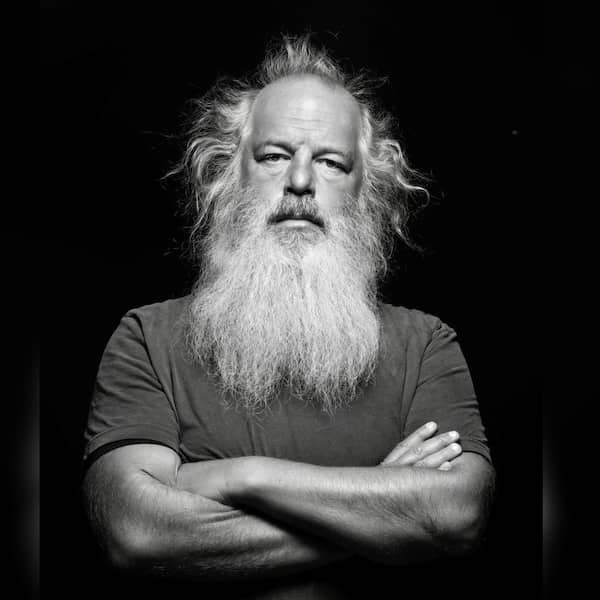
Need proof? Look a subset of his roster. If none of these names are in your Spotify library, I’ll eat one of my many Yankee hats: The Beastie Boys, Run-DMC, Kesha, Adele, Ed Sheeran, Lady Gaga, Metallica, Slayer, Red Hot Chili Peppers, Rage Against The Machine, System of a Down, AC/DC, Audioslave, Weezer, Aerosmith, Linkin Park, Slipknot, The Avett Brothers, Tyler Childers, Kid Rock, Johnny Cash.
You’re probably thinking what I thought the first time I pulled up Rick’s Wikipedia. “How?”
The Creative Act is a glimpse into his how.
Re-reading it this time, it was the second half of the title, A Way of Being, was what caught me. This was supposed to be reviewing another productivity book, with a slant for my fellow creatives out there. Some new tools for the toolkit.
Instead, it became a mirror showing me why none of my tools were working anymore.
Why pushing harder was making everything worse.
Why the source I’d been trying to squeeze dry was never inside me to begin with.
And why I was smashing my head into my keyboard getting my posts together for the week.
THE CREATIVE ACT: A WAY OF BEING
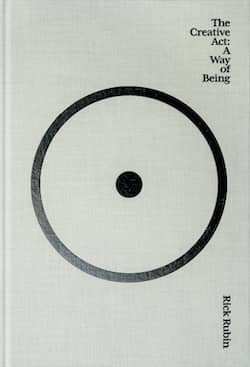
Author: Rick Rubin
Published: January 17, 2023
Length: 432 pages
WHY THIS BOOK MATTERS
Rick Rubin’s The Creative Act isn’t really about making music, despite Rubin’s legendary status as a producer. It’s about the deeper practice of being a vessel for creative work—and what happens when we mistake ourselves for the source instead of the channel.
Since I came up with the idea for The 52 (in the shower – no shit, that happens in real life), I knew Rubin would make the list. But when it came time to write about it, I picked up this book thinking I’d find productivity hacks for creating while exhausted.
What I found instead was a mirror reflecting back why I was exhausted in the first place. Instead of tapping into Source and letting it flow, my big ol’ ego had been telling me I WAS the source – and then squeezing me like a bookie I owed money.
THE ESSENTIALS: 3 CORE IDEAS
1. You’re Not The Source, You’re The Vessel
We begin with everything: everything seen, everything done, everything thought, everything felt, everything imagined, everything forgotten, and everything that rests unspoken and unthought within us. This is our source material, and from it, we build each creative moment. This content does not come from inside us. The Source is out there.
Rubin doesn’t teach you how to push harder. He says to stop pushing altogether.
For those of us who have built our entire identity around effort, that’s terrifying.
I’ve been trying to squeeze creativity out of myself like the last bit of toothpaste from the tube. Rubin suggests the opposite: we’re not the source, we’re the vessel. The harder we squeeze, the more we block the flow.
He talks about creating “a space so free of the normal overpacked condition of our minds that it functions as a vacuum. Drawing down the ideas that the universe is making available.”
When did you last have a vacant space in your mind? When did you last stop long enough for an idea to find you instead of hunting ideas down like a bounty hunter?
2. Breaking Is Part Of The Process
In Japanese pottery, there’s an artful form of repair called kintsugi. When a piece of ceramic pottery breaks, rather than trying to restore it to its original condition, the artisan accentuates the fault by using gold to fill the crack.
I’ve read about kintsugi in a ton of productivity books (surprise, surprise), but this time, these lines got a thick underline. I’ve been treating my increasing exhaustion, my shortening temper, my inability to be present as failures to fix. Problems to solve. Weaknesses to overcome through more discipline, better systems, harder work.
What if the breaking is the point?
What if burning out isn’t failure but transformation? What if the cracks appearing in my perfectly optimized life aren’t meant to be hidden but highlighted?
Rubin writes: “The scar also tells the story of the piece, chronicling its past experience.”
Maybe those of us breaking under the weight of our own ambition aren’t failing. Maybe we’re being prepared to hold something different.
3. Discipline Means Harmony With Time, Not War Against It
Discipline and freedom seem like opposites. In reality, they are partners. Discipline is not a lack of freedom, it is a harmonious relationship with time.
Navy SEAL Jocko Willink’s “Discipline Equals Freedom” crept into my esoteric creative space, crossing genres just like Rick. (“Clever Girl,” says Muldoon right before the raptor eats him.) I’ve been using discipline as a weapon against time—trying to extract more from each hour, optimize every margin, turn every moment productive. That’s not discipline. That’s a sick form of violence, where I’m both perpetrator and victim.
Real discipline, according to Rubin, means creating “sustainable rituals that best support your work.” It means accepting the universe’s timetable instead of imposing your own. It means working with your natural rhythms instead of declaring war on them.
It’s a lesson I keep re-learning over and over again, usually in the shower or in a tin can floating above Earth: I’m better when I’m still. Not because stillness is lazy, but because stillness is where the work actually happens.
THE ENDURANCE FACTOR
This book will outlast your current crisis because it’s not really about your current crisis. It’s about the eternal tension between effort and grace, between pushing and receiving, between being the creator and being the created.
Every generation discovers this truth in their own way. The Stoics called it amor fati—love of fate. The Taoists called it wu wei—effortless action. Rubin calls it being a vessel. But the message endures: the harder we grasp, the less we hold.
Your burnout will pass. Your current project will ship or it won’t. Your metrics will go up or down. But the question Rubin poses will remain: Are you willing to empty yourself enough to be filled with something worth sharing?
KEY QUOTES
If you start from the position that there is no right or wrong, no good or bad, and creativity is just free play with no rules, it’s easier to submerge yourself joyfully in the process of making things.
For those battling imposter syndrome, read this again. There’s no right way or wrong way. What matters is YOUR way. You’re the only person who’s ever existed, who’s ever seen the world from your POV. The fact that the work comes from you is what makes it “right.”
When making art, the audience comes last.
‘Write a song people will like.’ ‘Make the movie that’ll be the summer blockbuster.’ But whose movies get remembered? Tarantino. Scorsese. Nolan. When’s the last time you saw a summer blockbuster that wasn’t a green screen and a shit script? Make it for you. Because you like it. You’ll find your people.
To the best of my ability, I’ve followed my intuition to make career turns, and been recommended against doing so every time. It helps to realize that it’s better to follow the universe than those around you.
When you need to figure out the best path forward, listen to your gut. It’s your work, your art, your life. Trust the signal you’re already hearing.
The work reveals itself as you go.
I’m seeing this happen in real time as I write my novel. Characters do unexpected things. Settings fall into place. For too long, I thought you find the path in the planning. But you find it in the doing.
When you’re on a roll in the Craft phase, work toward a full first draft. Maintain the momentum. If you reach a section of the work that gives you trouble, instead of letting this blockage stop you, work around it.
Sharing this one for my fellow creators. The work doesn’t need to happen sequentially – it needs to happen eventually. If you’re stuck, skip that part and hit something else.
We’re not playing to win, we’re playing to play.
I occasionally get tattoos for things I need to keep top of mind. This might be next.