


Caring if people liked me almost ruined my life.
I haven’t yet paid a therapist enough money to figure out exactly where it came from, but I have a general idea.
All families are fucked up in their own way, and ours was no different. Mom’s side were a particular breed of Massholes: parents who withheld affection and sisters with sharp claws and small minds. Her mom and dad didn’t even show up to her wedding because they didn’t like my dad.
They were nothing if not consistent, because they walked out on us grandkids, too.
It was a sunny summer afternoon in 1996 in Upstate New York, the day before we were supposed to visit the Baseball Hall of Fame in Cooperstown. I didn’t hear the full conversation at the kitchen table, but it ended with my grandfather standing up and saying, “I don’t have to take this shit.”
They were packed in less than 10 minutes.
Mom: “You don’t have to do this.”
Grandma: “We have four other kids.”
Then they were gone. Leaving my 8-year-old cousin at our house.
I spent years wondering what was wrong with us. Why were we so easy to walk away from?
That pattern followed me everywhere. Middle school edges of friend groups. High school pretending to fit in. Business school teaching me to please clients and kiss ass. Recruiting, where success meant people liking me.
Somewhere in my 30s, I snapped. I let the kid out—the one who spent hours reading Calvin and Hobbes, coming home with grass stains and blood on his shirt. The high schooler at punk shows on the edges of mosh pits.
And for the first time in two decades, I liked myself.
I needed this book when I was 22. I found it at 39.
THE COURAGE TO BE DISLIKED
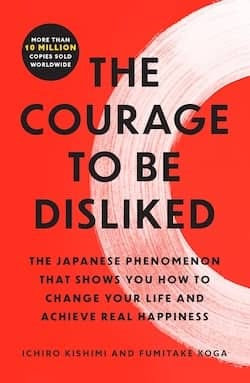
Authors: Ichiro Kishimi and Fumitake Koga
Published: December 12, 2013
Length: 288 pages
WHY THIS BOOK MATTERS
I picked this book up when I was almost 40, years after I’d already made the choice to stop playing the approval game.
I had three kids under 5. A demanding corporate role. And I was building a business in the margins of my life—posting publicly, knowing it could damage my career, doing it anyway.
The book didn’t teach me something new. It validated every risk I’d taken since that “fuck it” moment in my 30s.
Kishimi and Koga are a philosopher and a writer who spent years translating Adlerian psychology into something functional. They packaged it as a dialogue between a teacher and a student—the student brings up every possible objection (to the point where I wanted to tell them, “All right, we fucking get it”), but that thorough examination leaves no room to dodge the truth.
The big idea: your unhappiness is a choice. And you can choose differently.
I’d already chosen. This book explained why it was the right choice.
If you’re building something that matters while everyone around you is asking why you can’t just be happy with what you have—this book will make you feel less alone. And it’ll give you the framework to keep going.
THE ESSENTIALS: 3 CORE IDEAS
#1: Your Unhappiness is a Goal You’ve Chosen
At 22, I was selling corporate sponsorships for two professional sports teams, the Philadelphia Flyers and 76ers.
My friends from Villanova had landed those Big 4 consulting jobs in New York that I told myself I didn’t want to take. But come senior year, I found myself a little jealous of the prestige of that whole operation. Offer letters months in advance. Manhattan apartments. Partying in Frank Sinatra’s city.
But I landed a gig working with NHL and NBA teams. I’d run into professional athletes in the hallways (including almost knocking over the now-GM of the Flyers right after he was traded to Philly as a player). In my mind, my career was just as credible as those of my consulting buddies.
I worked 80-100 hour weeks making just enough money to make rent. Cold calling all day. Suit jacket on to entertain clients (not mine) in the suites at night.
I fucking hated it.
Six months in, after working my thirteenth straight day, I drove myself to the ER on a Sunday night.
I was convinced I was having a heart attack. It ended up being a panic attack (the first of many, as it’d turn out).
Hooked up to an EKG machine, I saw the situation clearly: I was going to kill myself doing a job I hate. And for what? So I can tell people I work in pro sports?
I quit the next day with nothing else lined up.
My boss asked me what I was going to do next.
My response: “I don’t know, but it can’t be this.”
#2: The Approval Game is Rigged (and You’re Playing It Anyway)
I thought I’d learned my lesson after the sports job. Nope.
I ran away from corporate America and worked in a friend’s living room for almost two years at a startup that was going nowhere serious. I was broke—$30k a year broke, with shitty health insurance—but at least I wasn’t having panic attacks.
Eventually I needed to grow up and make money. I got into recruiting like most of us do: by accident. $18.50 an hour, no commission, but I was glad to have it.
And of course, I picked another profession where success was entirely contingent on people liking me.
I’d leave myself voicemails to practice my cold call pitches, then listen back and hear this fucking gross “customer service” version of my voice that I hated. But that’s who I thought I needed to be to get hiring managers and candidates and VPs to like me enough to do business with me. It worked well enough to make good money and get promoted. It didn’t make me happy, but having money and a little status was way better than being broke and lost.
As I tried to make strategic jumps to advance my career, I failed at two consecutive recruiting jobs in my 30s. I was about to quit my third because I went from having an amazing boss to a terrible one. My “fuck this place” energy was through the roof.
Then I hired my next boss. Instead of playing the game and putting on the political face, I was totally honest with her about where I was. I told her how I felt, what was broken, and that I was getting my resume ready. And something wild happened:
She listened.
More than that, she actually made my old boss apologize to me in person. Then empowered me to go do good work.
I’d spent a decade trying to control what other people thought about me. Every hiring manager, every candidate, every VP I worked with—I’d given all of them permission to determine whether I was having a good day or a bad one.
Ask any married person if they think they can control what their spouse thinks about them.
I’d built my entire career on that stupid assumption. But it ended up that having the courage to be honest – and not give a shit about what the other person thought or said – was the actual way to get what I wanted.
That was a huge paradigm shift for me.
#3: Happiness is Believing you’re Useful to Someone
I’d been repressing the kid in me. In that “fuck it” moment when I opened up to my boss, I finally let him out, because the alternative was burning my whole life down and starting over.
I was a 30-something handing the controls back to the kid who’d spend hours reading Calvin and Hobbes, his days exploring the woods and riding bikes and coming home with grass stains, blood on the shirt, and a smile. The high schooler who felt most at home at punk shows, taking hits on the edges of mosh pits in sweaty venues.
My career took off. My marriage got better. And for the first time in two decades, I genuinely liked myself.
Like all pendulums, it swung too far in the opposite direction. I pissed off my wife plenty. I frustrated the hell out of that good boss of mine. I was an impatient father.
But things eventually settled. Instead of acting like a rebellious, self-destructive teenager, I was channeling that energy into building. That’s where I became a professional. Where I turned pro.

Kishimi’s whole point: you can’t find happiness chasing others’ approval. You have to source it internally. The only way to do that is to shift your focus from something you can’t control—what others think—to something you can: how you contribute to the world you’re in.
I know my kids love me just because I’m their Dad. Michelle might occasionally kick me out of bed when I mouth off, but she still smiles when she’s telling me how annoying I am.
THE ENDURANCE FACTOR
The trap doesn’t change. We’re wired to want people to like us. We also all want to be ourselves.
Our parents faced it. Our kids will face it. So will theirs. They’ll grow up with the same bullshit we did—systems and institutions designed for conformity, not individuality. They’ll have to find their way back to being themselves.
The book builds a compounding skill—the ability to separate your self-worth from others’ opinions. It helps you stop asking, “What will they think?” and start asking, “What do I want?”
I needed it at 18. I found it in my 30s. Give this book to a high school kid before they pick a major to impress their parents.
Thanks for reading. You’re part of a growing, ambitious group striving towards something—a career move, an entrepreneurial venture, a 2nd act.
If this landed, share it with someone who needs to stop anchoring their happiness in the minds of others.
And if you’re feeling trapped by the golden handcuffs—building something on the side while trying not to burn down what’s working—grab the Golden Handcuffs Diagnostic. It’s free, and it might clarify some things.
Up next, we’ll dive into a book that’s all about getting shit done in a way that ensures you love the journey as much as the destination.
Until then—keep building, keep growing, and keep going.
Mike