


LEONARDO WAS ALWAYS MY FAVORITE NINJA TURTLE.
Leader of the crew. Two swords. Cool under pressure.
So when I first heard about Miyamoto Musashi on Jocko Podcast—the real-life sword-slinging strategist who pioneered the two-sword method— I was locked in immediately.
He wasn’t a cartoon or a myth. He was a warrior who fought over 60 confirmed duels, many to the death.
One-on-one, five-on-one, didn’t matter. He survived them all.
Then, at the end of his life, he documented the mindset and method that had kept him alive—and deadly—through every kind of fight.
Not in theory. In practice.
The Book of Five Rings is the distilled strategy of a man who mastered his craft by living it, bleeding through it, and thinking deeply about every move.
It’s held up since the 1600s—not because of nostalgia, but because the principles still shape how serious people operate.
If you care about mastery, strategy, and building something that lasts—this book belongs in your hands.
Let’s get into it.
THE BOOK OF FIVE RINGS
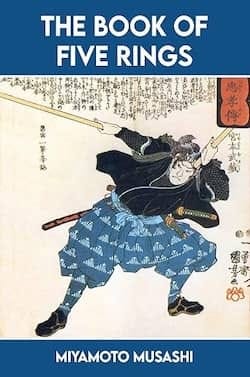
Author: Miyamoto Musashi
Written: 1645
Length: 45 pages
WHY THIS BOOK MATTERS
This isn’t a book about fighting.
It’s a book about mastery.
Musashi may have written it from the perspective of a man with a sword in his hand, but the lessons extend far beyond combat. This is a manual for strategic clarity, mental precision, and inner discipline—written by someone who refined his craft under real pressure.
The Book of Five Rings strips away illusion. No motivation hacks. No style over substance.
Just the quiet, brutal truth of what it takes to win consistently—at anything that matters.
Musashi saw strategy not as technique, but as truth revealed through repetition. A way of seeing. A way of living. A way of moving forward with purpose, regardless of conditions.
If you’re building something long-term—
If your days are spent crafting, honing, leading, learning—
This book hands you a mirror. Then it hands you a weapon.
Not to fight others.
To conquer the drift, the doubt, and the noise inside.
THE FOUNDATION
Like a true warrior, Musashi didn’t just fight battles. He studied them.
He dissected every duel, every pattern, every shift in rhythm—not to win by brute force, but to understand the essence of conflict. What emerged was a philosophy built around five elements: Ground, Water, Fire, Wind, and Void. Each one reveals a layer of the warrior’s path:
Ground is structure: principles, preparation, and positioning.
Water is adaptability: form without fixation, flow without hesitation.
Fire is engagement: fast decisions, fierce pressure, clean execution.
Wind is awareness: of other systems, styles, and how they break.
Void is transcendence: the pure instinct that emerges when training becomes truth.
But Musashi’s core insight was this:
“You must never let your strategy be influenced by the enemy. Instead, you make him obey your spirit.”
That’s not just a battlefield doctrine. It’s a way of life.
When you internalize your method so deeply that every situation becomes a canvas for execution, you’re no longer reacting. You’re leading. You’re hunting. You’re free.
That’s the state Musashi calls invincibility.
Not arrogance.
Just the calm of someone who’s fought their way past uncertainty.
THE ESSENTIALS
PERCEPTION
Musashi doesn’t separate combat from life. Every insight in this book is meant to transfer—from the dojo to the street to your career to your soul.
“See distant things as if they were close, and close things with distance.” Strategy demands perspective. If you fixate on small details, you lose sight of the broader threat. If you ignore the nuance, you miss the real openings.]
The rhythm of life follows the same cadence as the battlefield: “All things entail rising and falling timing. You must be able to discern this.”
And beneath it all, Musashi drives home a harder truth: every day is a test of progression. Your clearest opponent is who you were yesterday. That’s the lens real mastery requires—one that’s brutally inward before it’s ever strategic outward.
This is the inner war. The real opponent is who you were.
ACTION
Musashi is ruthless in his instruction: you either act decisively, or you die.
“To hit in one timing” means striking before your opponent has made up his mind. It’s the art of finding the decisive moment—and committing without hesitation.
He teaches how to injure the corners—to unbalance systems not through brute force, but by targeting weak points that unravel the whole.
He warns against repeating failed moves: “If the enemy thinks of the mountain, attack like the sea.” Predictability is death.
And he reminds us that spirit and stance must be trained until they become indistinguishable: “Make your everyday stance your combat stance.”
In short: real mastery isn’t flashy. It’s deeply embodied.
WILL
The through-line of this book is simple but severe:
“Generally speaking, the Way of the warrior is resolute acceptance of death.”
Musashi’s view of strategy isn’t theoretical—it’s existential.
You must be willing to lose your life. Or at least, the life you’re clinging to.
That applies far beyond the sword. If you’re trying to build something that matters—if you’re fighting to protect your time, your energy, your values—then you’ve already entered the battlefield. The cost of hesitation is high. So is the cost of clinging to a single “weapon.”
Musashi makes this clear:
“You should not have a favorite weapon. To become over-familiar with one weapon is as much a fault as not knowing it sufficiently well.”
He’s not just talking about swords.
He’s referring to our attachment to any single identity, strategy, or path.
Whatever your enemy is—resistance, burnout, fear, complexity—you fight it with what you’ve got. You move. You adapt. You find a way to win.
Because that is the Way.
THE ENDURANCE FACTOR
This book has survived 400 years not because it’s poetic, but because it’s useful.
In only 45 pages, Musashi shares a wealth of enduring wisdom that speaks to every creator, leader, and fighter trying to win a battle in a world of chaos:
It tells you how to survive confrontation with systems larger than you.
It reminds you not to let tools become crutches.
It teaches you to think with clarity and act with force—without needing to be seen.
And above all, it offers a mental operating system for strategy, grounded in rhythm, trained through repetition, and built to hold up under real-world pressure.
In a world obsessed with optimization, Musashi reminds us:
“It will seem difficult at first, but everything is difficult at first.”
If you’re building a second act, mastering your craft, or navigating the daily fog of uncertainty, this book gives you something few others can:
A way to move forward when everything feels like war.
KEY QUOTES
“The Way is in the training.”
Relentless repetition is the foundation. You don’t think your way into mastery. You train your way there.
“To renew, when deadlocked with the enemy, means that without changing our circumstance we change our spirit.”
Breakthroughs rarely come from changing your environment. They come from shifting your posture—mentally, emotionally, strategically—until a new path becomes visible. Same battlefield. Different perspective.
“Today is victory over yourself of yesterday; tomorrow is your victory over lesser men.”
The order matters. First, you beat who you were. Only then do you become the kind of person who can outperform others—not through ego, but through evolution. Anything external is just proof of internal progress.
“If you know the Way broadly, you will see it in everything.“
This is the heartbeat of strategy (and perhaps my favorite quote in the book). If you go deep enough into one craft, you begin to spot the same rhythms, the same leverage points, the same truths—everywhere else. The Way reveals itself in patterns. And once you see the pattern, you can move with precision in any domain.
THE LEGACY TEST
Will this book shape how you operate ten years from now?
If you let it, yes.
The Book of Five Rings isn’t filled with trends, hacks, or motivation. It’s filled with frameworks for how to think, train, act, and win—in any field, at any scale, under any pressure.
It doesn’t give you answers. It sharpens your judgment.
This book earns its place on the shelf of anyone who’s not just chasing performance, but building a life rooted in craft, clarity, and execution.
And if you revisit it once a year, you’ll see something new every time—because you will be different every time.
That wraps up the “cheat code” book of the thoughts by the swordsman to ever live. If you really want to nerd out about the legendary warfighter, I recommend the historical fiction work Musashi: An Epic Novel of the Samurai Era. Though a word of warning—I’d go the Kindle or Audible route if you don’t want to be lugging around a cinderblock-sized book through a sweaty summer. This one clocks in at 984 pages. And it doesn’t resolve until the very last page.