


I HAD A CONVERSATION THAT RUINED MY WEEK.
Not because it went badly. Because it went exactly how every conversation goes.
“How’s work?”
“Tons of balls in tons of balls in the air.”
“How are the kids?”
“Adorable little terrorists destroying my home.”
“What’s new?”
“Same daily chaos.”
I’ve become a human small talk generator. And I didn’t even notice it happening.
Then I picked up Naval’s book again.
And realized why every re-read pisses me off.
THE ALMANACK OF NAVAL RAVIKANT: A GUIDE TO WEALTH AND HAPPINESS
Photo by Anik Mandal on Unsplash
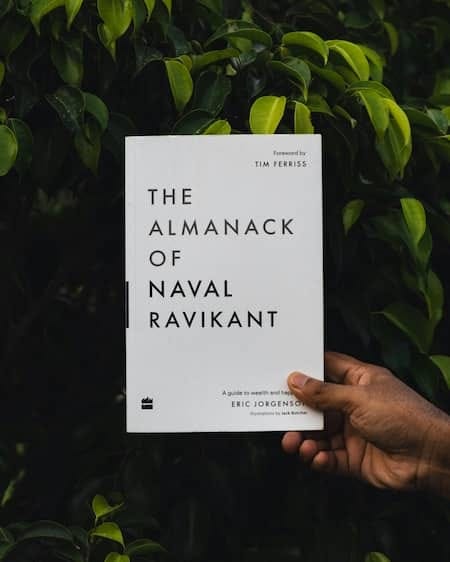
Author: Eric Jorgenson
Published: August 15, 2020
Length: 242 pages
Buy: https://amzn.to/4rWs9sg
WHY THIS BOOK MATTERS
This is a book summarizing the mind of a guy who got rich, then told people money won’t make them happy.
Naval Ravikant built AngelList, invested early in Uber and Twitter, and then spent years explaining why chasing wealth is a trap.
But here’s the twist – he’s not wrong.
This isn’t your typical “10 steps to success” book – it’s more like eavesdropping on a brilliant friend who happens to think out loud about money, meaning, and mental models. Compiled from tweets, podcasts, and interviews, it’s Naval’s brain in book form: part wealth-building playbook, part Buddhist philosophy, part physics textbook.
Most people read it for the money stuff. The smart ones stay for the philosophy.
Not because Naval’s some guru spouting ancient wisdom, but because he does two things philosophers rarely do: gives you his raw, unfiltered take on what actually works, then tells you to ignore anything that doesn’t click for you. He’ll teach you to get rich by being yourself, then convince you that being rich doesn’t really matter.
It’s Silicon Valley meets the Bodhi tree, and somehow it all makes sense.
THE FOUNDATIONS
From page one, Naval is a systems thinker. I’m a systems collector—always hunting upgrades for my mental OS. These hit hardest:
The Retirement Paradox: Everyone’s racing toward retirement, but Naval flips it: “Retirement is when you stop sacrificing today for an imaginary tomorrow.” You don’t need millions to retire – you need to find work that feels like play. Most people are already retired, they just don’t know it because they’re doing work they hate.
Specific Knowledge > Hard Work: Working hard is overrated. Working on the right thing is everything. Your specific knowledge is the stuff you can’t Google, can’t be trained for, and feels like play to you but looks like work to others. It’s usually hiding in the things people compliment you on but you dismiss as “just natural.”
The Leverage Ladder: Forget climbing the corporate ladder. Climb the leverage ladder instead: labor (no leverage) → capital (some leverage) → code and media (infinite leverage). One good tweet can reach more people than a lifetime of one-on-one meetings. One piece of code can work while you sleep. Most people are still trading time for money like it’s 1850.
Happiness is a Skill, Not a Reward: We’ve got it backwards – happiness isn’t the prize at the end of success. It’s a skill you develop through practice. Naval’s formula: Happiness = Reality – Expectations. Want to be happier? Either change reality (hard) or lower expectations (easier). The richest people are often the most anxious because their expectations outpaced their reality.
Read for Foundations, Not Facts: Stop reading books cover to cover. Read the ones that call to you, skip the boring parts, quit the bad ones. Better to deeply understand 10 great books than to skim 100 mediocre ones. The goal isn’t to read more books – it’s to find the few that rewire your brain.

THE ESSENTIALS
Your Specific Knowledge is Your Monopoly
Stop competing where everyone else is competing. Your specific knowledge is that weird combination of things only you can do – usually found at the intersection of what feels like play to you, what you did as a kid, and what people ask your advice on. It’s not about being the best programmer or marketer. It’s about being the only one who can do what you do.
Code and Media are the New Leverage Labor
Sitting your ass in a cubicle, typing away, leverages nothing. Capital leverages a little. Code and media leverage infinitely. One tweet can reach millions. One piece of code can serve billions. Yet most people are still trading hours for dollars. Build once, sell twice, then sell forever. That’s the game now.
Happiness = Reality – Expectations
All the meditation apps and gratitude journals are just hacking this equation. Lower your expectations or improve your reality. Most misery comes from the gap between them. The happiest people either have everything (rare) or want nothing (difficult, but learnable).
Reading is Downloading Software for Your Brain
Don’t read to finish books. Read to install new mental models. The best books are the ones you’ll read 20 times over 20 years and see something new each time. Start with the classics – they’ve survived for a reason. Skip anything that feels like homework. (As someone who is usually juggling 3-5 books and feeling like a quitter when I put one down, this was liberating.)
Desire is a Contract You Make with Yourself to Be Unhappy
This fucking leveled me. Until you get what you want, you’ve agreed to be miserable. Most people are walking around with 50 open contracts. Close them. Either get the thing or decide you don’t want it. Peace comes from having fewer desires, not fulfilling more of them.
The Principal-Agent Problem Runs Everything
When someone else is making decisions with your money, your health, or your career, their incentives aren’t yours. Doctors get paid to prescribe. Employees get paid to look busy. Politicians get paid to get re-elected. Understand the incentives, understand the behavior.
You’re Not Lacking Resources, You’re Lacking Resourcefulness
Everyone wants more time, money, connections. But constraints force creativity. The people who win aren’t the ones with the most resources – they’re the ones who do the most with what they have. Stop waiting for perfect conditions. They’re not coming.
KEY QUOTES
“Specific knowledge is knowledge you cannot be trained for. If society can train you, it can train someone else and replace you.”
Your degree is worthless. Your weird combination of skills that nobody can replicate? Priceless.
“If you can’t see yourself working with someone for life, don’t work with them for a day.”
Most people choose business partners like they’re picking teammates for dodgeball. Naval’s playing infinite games.
“Reading is faster than listening. Doing is faster than watching.”
Stop consuming productivity content. Start producing literally anything.
“Peace is happiness at rest. Happiness is peace in motion.”
Happiness isn’t hiding somewhere. It’s a skill you develop, not a prize you win.
“Society will pay you for creating things it wants. But society doesn’t yet know what it wants. That’s your job.”
Stop asking what people want. Show them what they didn’t know they needed.
“A fit body, a calm mind, a house full of love. These things cannot be bought – they must be earned.”
Bezos can’t Amazon Prime your inner peace. Some things—the most important thing—require actual work.
“Desire is a contract you make with yourself to be unhappy until you get what you want.”
I don’t usually repeat quotes, but this single sentence was worth the whole book (and it was originally a Tweet). Every goal is a decision to be miserable until you hit it. Choose carefully.
HOW TO ACTUALLY APPLY THIS
Look, reading Naval is like learning to swim by watching Olympic footage. Impressive, but you’re still going to drown.
Here’s how to not die:
Start with ONE thing.
Naval talks about 50 mental models. Pick one.
I started with “specific knowledge” – spent a month figuring out what I knew that nobody could Google. Turns out my weird combo of leadership + writing + parenting + a willingness to share the mess in public is actually valuable. Who knew?
The 5-minute wealth hack: Every morning, ask: “What am I building today that will make money while I sleep?” Most days the answer is “nothing, I’m in meetings.” That’s why I work early mornings and late nights for me. If “nothing” was your answer, too, consider it a problem worth examining.
Kill one desire per week. Naval says desire = suffering. Start small.
Week 1: Stop checking social media likes.
Week 2: Delete one streaming service.
Week 3: Unfollow anyone who makes you feel behind.
By week 10, you’ll realize most of your wants were just socially acceptable addictions.
The partner test: Before your next meeting, ask yourself Naval’s question: “Would I work with this person for life?” If the answer’s no, that meeting should be your exit interview. Life’s too short for temporary people.
Read like you’re dying (because you are): Naval reads 20-50 books simultaneously. Try 3. When you get bored, switch. When a book sucks, quit. Your 8th grade teacher lied – you don’t have to finish books. Read for insights, not completion medals.
Build your judgment: Every decision you make, write down your prediction. Check back in 6 months. You’ll realize your judgment sucks. Good. Now you can fix it. Most people never even check.
THE LEGACY TEST
Here’s what Naval tells you: His path worked for Naval.
A guy who could code before it was cool, angel invested when nobody knew what that meant, and thinks in systems while the rest of us think in salary negotiations.
Your path will look different. It has to.
But the principles? Those are universal. Build assets, not resumes. Choose freedom over comfort. Develop your own judgment over someone’s recommended credentials. Create value before capturing it.
The real tragedy isn’t that most people won’t read Naval. It’s that the ones who do will treat his words like scripture instead of a starting point.
Stop reading about wealth. Start creating it.
Stop optimizing your life. Start living it.
Stop preparing to be happy. Start practicing it.
Because in the end, Naval’s greatest insight isn’t about money or success or even happiness.
It’s that you already have everything you need.
You just haven’t started yet.