

5:27 AM on a Thursday.
I’d done everything right. In bed by 10:30. Alarm at 5. A water bottle with an LMNT packet, a chilled Neutonic to caffeinate. My Sacred Hours were locked and loaded—90 minutes to work on the business before the chaos begins.
And then my 4-year-old appears at the bottom of the stairs. He’s scared. He doesn’t want to go back to sleep. He wants to hang with Dad.
And my first thought was, “You’ve gotta be fucking kidding me.”
I know my 80-year-old self will hate me for that. But it’s the truth. A flood of frustration hijacked my brain—immediate and justified.
Because I’m doing everything right. I’m sacrificing sleep. I’m protecting this time. I sit down at the desk ready to give it my all while most people are still asleep.
And the universe doesn’t give a shit.
The rest of my day was spent scrambling to find the hour I just lost—the hour that was mine.
You know this feeling. The sick kid call from school. The partner who needs you when you’re already overstimulated. The Slack message at 7:42 PM from the colleague who doesn’t believe in your ‘bedtime routine’ boundaries. The list of perfectly reasonable explanations for why your inner peace gets hijacked.
Here’s the uncomfortable truth I keep having to relearn: that frustration? That sense of being a victim of my circumstances? It’s a trap. A sneaky one, because the frustration feels so goddamn earned.
And yet—the lesson remains. The 4-year-old isn’t the obstacle to my stillness practice.
He is the practice.
So, around 11PM that evening, when I finally clawed back that hour and finished my newsletter, I looked at my bookshelf. My eyes wandered over the familiar spines to see which book I’d revisit next for this series.
My brain wasn’t perusing. It was scanning. Because as soon as I saw Ryan Holiday’s Stillness is the Key, I thought back to my morning visitors: my son and my frustration.
And I knew I needed to re-read it. Again.
STILLNESS IS THE KEY
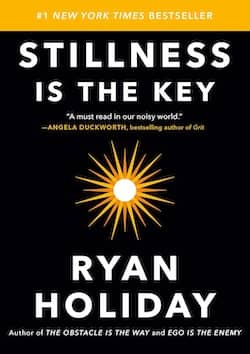
Author: Ryan Holiday
Published: October 1, 2019
Length: 288 pages
Buy: https://amzn.to/4qn3SLv
WHY THIS BOOK MATTERS
I first picked up this book in 2019. I’ve been a Ryan Holiday fan since The Obstacle is the Way (Book 3 in this Outlast Yourself series), so this was a day-one buy. And I fucking needed it.
My wife was pregnant with our first. I was working a demanding corporate job. And I was also spending mornings and nights trying to record a rock album with my brother—jamming as much as I could into my “free time” so I could have it done before the baby came.
[NARRATOR: It wasn’t done before the baby came. In fact, it took another 18 months to complete.]
My mind was in a thousand places. Contemplating fatherhood. Feeding the insatiable beast of my own creative ambitions. Climbing the corporate ladder like a good little business school grad. And somehow trying to be present for a wife whose body was literally building another human.
But at night, I started reading. And it felt like he’d written this one specifically for me.
Six years later, I still pick this book up twice a year. The circumstances have evolved—three kids under 5 now, a bigger title, a business I’m building in the margins, and (because I apparently despise peace) a new puppy.

But the core tension hasn’t changed. My life is louder. Fuller. More demanding. And stillness feels more essential—and more elusive—than ever.
Here’s what this book forces you to confront: like most things in life, your inner peace is entirely on you.
Most people are waiting for the right conditions to find stillness.
Holiday’s message is: nope.
The conditions are right now. They always will be. And if you keep outsourcing your peace to things outside your control, you’ll spend your entire life waiting for a calm that never comes.
Stillness isn’t a destination. It’s a muscle you build. And like any muscle, it can either atrophy without use or strengthen under resistance.
THE ESSENTIALS: 3 CORE IDEAS
1. Stillness Is a Practice, Not a Prize
Most of us are clinging to a fantasy: someday, when the chaos settles, we’ll finally have peace.
When the kids are older. When the business is profitable. When I hit that number in my bank account. When I get the promotion. Then I’ll be able to think clearly. Then I’ll meditate. Then I’ll journal. Then I’ll take the long walks and find the stillness everyone keeps talking about.
This is a lie. And like all dangerous lies, it’s deadly because it sounds so reasonable.
Holiday’s core argument is that stillness isn’t something you achieve and then possess forever. It’s a practice—like exercise, like writing, like any skill that degrades without repetition. You don’t do one workout and stay fit for life. You don’t journal once and have a clear mind forever.
The 4-year-old showing up at 5:57 AM isn’t interrupting my stillness practice. That moment—the flash of frustration, the choice of how to respond, the opportunity to either spiral into resentment or breathe and be present with my scared son—that is the practice.
Every interruption is a rep.
The Stoics understood this. Marcus Aurelius didn’t write his Meditations from a spa retreat. He wrote them while running an empire, fighting wars abroad, wrestling with politicians and plagues, and burying his children. The obstacle wasn’t blocking his path to stillness—the obstacle was the path. (Sound familiar?)
You have to stop thinking your chaos is preventing you from developing stillness. The chaos is the training ground to strengthen your stillness muscle.
This reframe is the liberating permission you need to start now. Not when things calm down. Now. In the mess. With the puppy barking and the computer pinging and the phone vibrating and the toddler telling you that Chase is the best dog in the Paw Patrol for the forty-seventh time today.
2. You Have to Actively Protect Your Mental Space
Holiday uses a metaphor from Daoist philosophy that’s stuck with me for years: think of your mind as a pool of muddy water.
When thoughts churn, the mud churns too. When you’re constantly reacting—to news, to notifications, to the endless scroll of other people’s curated lives—the water never settles. You can’t see what’s beneath the surface. The turtles, the plants, the rocks at the bottom, all obscured by the mud you keep stirring up.
Stillness requires letting the mud settle.
This sounds passive, but it’s actually one of the most active things you can do. The world we live in is designed to keep your water churning. Holiday puts it bluntly: “Every time we open an app, there are a thousand people on the other side of the screen trying to keep us engaged.” Engineers, psychologists, slot machine designers, all optimizing to mine one thing: your attention.
And we wonder why we can’t think clearly. The minute we pull out our phone when we’re bored, we’re fighting an army of PhDs…which means we’re already fucked.
Protecting your mental space requires what Holiday calls “limiting your inputs.” You’re not going off the grid. You’re just being picky about what gets in. You don’t need to be constantly informed—that’s ego talking. Fear of looking ignorant. Fear of being left out. But most information isn’t urgent or important or even relevant to your day-to-day. Consuming it in real time does nothing but churn the water.
Holiday’s practical advice: don’t consume in real time. Wait a few days. What’s actually important will still be important. What’s not will have resolved itself.
Napoleon famously waited three weeks to open his mail—and loved noting how many “urgent” issues had simply disappeared. I’ve been implementing this practice with email threads. I can’t go three weeks (I need to keep my job, and I can’t blame the delayed responses on horses dying in transit), but I am more intentional about batching when I check and respond to emails. If there’s a thread with 8 names on it, I weigh in only when absolutely necessary. And, lo and behold, there’s a bunch of shit that didn’t require my attention to begin with.
It’s also why I guard my Sacred Hours like a psycho. 5:00-6:30 AM. No email. No LinkedIn. No news (I stopped reading the news a year ago and have ‘missed’ absolutely nothing. People tell me what I need to know). That time is for the work that matters most, done in the stillest part of the day, before the world puts an outboard motor into my little lake.
It’s not enough to want stillness. You have to build walls around it.
3. Mind, Body, and Soul Are Non-Negotiable Partners
Letting the mud settle is step one, but it’s not enough. Holiday is clear: the mind cannot achieve stillness without the body and soul being in alignment. The three are inseparable.
You can’t think your way to peace while running on five hours of sleep. You can’t journal your way to clarity while your body is screaming for a walk. You can’t meditate your way to contentment while your soul is starving for meaning.
The body piece: We’re overstimulated, overscheduled, and chronically under-rested. We skip the workout to squeeze in another meeting.
Holiday calls bullshit on the “glorification of busy.” You are not your job. Time is literally your life—every task you take on, you’re trading a piece of your life for it. Is it worth it?
Walking isn’t just exercise. Kierkegaard saw it as necessary for keeping the mind agile. It’s moving meditation. He believed sitting too long would make you sick—you need to move the body to still the mind. So he’d walk miles and miles until his thoughts settled.
The paradox is real: sometimes stillness requires motion.
I won’t preach about the value of sleep, because I’m terrible at prioritizing it. But I’ll just say this: sleep isn’t laziness. It’s how you recharge the system that makes everything else possible. You can’t make good decisions while exhausted. You can’t be present for your family while running on fumes. My worst choices come on the heels of a bad night’s sleep. Do as Holiday says, not as I do. Prioritize your sleep.
The soul piece: This is where I’m doing the most work right now. Holiday argues that without a connection to something greater—God, Source, the universe, whatever you call it—life becomes meaningless.
Meaning is essential to stillness. Without it, you’re just managing chaos until you die.
I’m on my own journey back to spirituality after years away from the Catholicism I grew up with. I don’t have this figured out. But I know Holiday is right: you can’t have a still mind while your soul is in turmoil. The virtue piece, the meaning piece, the connection to something beyond yourself—it’s not optional. It’s foundational.
Mind, body, soul. Neglect one and the others suffer.
THE ENDURANCE FACTOR
Why will this book matter in 10, 20, 50 years?
Because distraction isn’t going away. The forces competing for your attention will only get more sophisticated. The chaos of modern life—the information overload, the always-on work culture, the thousand people on the other side of your screen—it’s not a temporary condition. It’s our new baseline. (Hooray).
And yet, the human need for stillness is ancient. The Stoics wrote about it. The Buddhists built entire philosophies around it. Every wisdom tradition in human history has pointed toward the same truth: inner peace isn’t found in external circumstances. It’s cultivated internally, through practice, through discipline, through the slow work of letting the mud settle.
The tactics will evolve. But the fundamental human struggle—to find calm in chaos, to be present in a distracted world, to access the deeper thoughts beneath the noise—that’s timeless.
This book isn’t a hack or a shortcut. It’s a manual for the under-rested, overstimulated masses to help us fight one of the oldest battles humans have ever fought: the war against our own restless minds.
Thanks for reading. You’re part of a small (but growing), ambitious group who are striving towards something—a career move, an entrepreneurial venture, a 2nd act.
If this landed, share it with someone who needs the reminder that stillness isn’t waiting for them at some future finish line.
And if you’re feeling trapped by the golden handcuffs—building something on the side while trying not to burn down what’s working—grab the Golden Handcuffs Diagnostic. It’s free, and it might clarify some things.
Next installment: a book about the courage it takes to stop living by other people’s expectations. The title alone pisses some people off. Can’t wait.
Until then—keep building, keep growing, and keep going.
Mike