


I AM A SPECK IN AN INFINITE UNIVERSE. I AM A FLASH IN THE NIGHT AMONG THE EONS OF EXISTENCE.
I am a ruler of an inner kingdom, protector of a sacred citadel, and an evangelist.
Both of these things are true.
So how the fuck is a loud-mouthed kid from Schenectady, New York supposed to reconcile that?
Lucky for us, better men than me have been wrestling with this exact paradox for thousands of years. Today we’re diving into the private thoughts of Marcus Aurelius—emperor, philosopher, and a guy who spent his nights writing notes to himself about doing his job without whining.
To some of you, he’s the last of the Five Good Emperors who kept Rome from imploding.
To others, he’s the old guy from Gladiator who Joaquin Phoenix murdered.
To Ryan Holiday, he’s a meal ticket.
DON’T. I see you hovering over that X button the second I said “philosopher.” Don’t bullshit a bullshitter—I know that look.
Stay. This man’s personal journal somehow survived 1,900 years—on the same planet where Epstein’s prison footage couldn’t make it a week. That alone should tell you something. This might be the book that’s shaped me more than any other in The 52.
(Might. I’m still non-committal twelve books in.)
So if you’re currently:
Trapped in a soul-sucking job with people you can’t stand
Circling the drain in a relationship that needs to die
Searching for the balls to start what you know you should
Trying to be everything to everyone while barely holding it together
This book will hit you. Hard.
And if it doesn’t? Find a mirror. Stare into it.
The problem isn’t Marcus.
MEDITATIONS: A NEW TRANSLATION (MODERN LIBRARY)
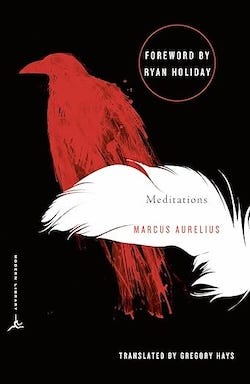
Author: Marcus Aurelius (translated by Gregory Hays)
Written: 170-180AD | Published: 1559 (first edition), 2002 (Modern Library translation)
Length: 240 pages
WHY THIS BOOK MATTERS
Marcus Aurelius wasn’t trying to write a bestseller.
The guy was running the Roman Empire—plagues, wars, the ancient equivalent of Reply All disasters—and he’s up at 3am scribbling notes to himself about staying on the path rather than being kept on it.
His personal journal. Not meant for you. Not meant for anyone.
Just the most powerful man on earth reminding himself:
Don’t correct people’s grammar when they’re making a point
Do your job without whining
Those annoying people? They’re going to die. So are you. Move on
This is a man who could execute anyone with a nod, writing “You could be good today. But instead you choose tomorrow.”
If that doesn’t hit, check your pulse.
THE ESSENTIALS: 3 CORE IDEAS
1. Control Your Controllables
Marcus had unlimited power and spent his nights reminding himself he controlled almost nothing.
“You have power over your mind—not outside events. Realize this, and you will find strength.”
Simple, right? Except I still check my phone 147 times a day like I can control what’s on it. Still rage in traffic like my anger moves cars. Still try to manage other people’s opinions like I’ve cracked the code on mind control.
The emperor of Rome is telling you: You control exactly two things. What you think and what you do.
Everything else? Not your department.
The cucumber is bitter? Then throw it out. There are brambles in the path? Then go around them. That’s all you need to know.
No philosophical hand-wringing. No deep analysis of why cucumbers dare to be bitter. Just throw it out. Move on. The emperor who handled material comforts “without arrogance and without apology” is teaching you to handle problems the same way.
When you accept that you control jack shit except your choices, something shifts. Tomorrow’s meeting matters less. Yesterday’s argument fades. You’re left with now.
And now is manageable.
2. People Will Disappoint You
When you wake up in the morning, tell yourself: The people I deal with today will be meddling, ungrateful, arrogant, dishonest, jealous, and surly.
Marcus knew: People are going to people. Your coworker will steal credit. Your kid will melt down in Target. Your spouse will forget the thing you’ve told them twelve times.
“That sort of person is bound to do that. You might as well resent a fig tree for secreting juice.”
And?
“The best revenge is not to be like that.”
You’re trying to build something real while everyone’s trying to drag you into their drama. But here’s what Marcus understood: “You can hold your breath until you turn blue, but they’ll still go on doing it.”
So stop holding your breath. Stop expecting figs to stop being figs. The annoying guy in your meeting? Temporary. Your incompetent boss? Temporary. You? Also temporary.
“People exist for one another. You can instruct or endure them.”
Two options. That’s it. Teach them or tolerate them. Getting pissed that they exist? Not on the menu.
3. Stop Auditioning
You want praise from people who kick themselves every fifteen minutes, the approval of people who despise themselves.
Jesus, Marcus. Just @ me next time.
We’re performing for an audience scrolling on the toilet. Checking likes from people who can’t like themselves. Building our identity on strangers’ opinions.
Enter their minds, and you’ll find the judges you’re so afraid of—and how judiciously they judge themselves.
I spent six months on LinkedIn writing what I thought people wanted. Checking analytics like vital signs. Building an audience for a version of me that didn’t exist.
Marcus faced the same trap. Everyone wanted their version of him—more warlike, more peaceful, more generous, more strict. His response? “Don’t be ashamed to need help. Like a soldier storming a wall, you have a mission to accomplish.”
Your mission isn’t their approval. It’s your work.
Today I escaped from anxiety. Or no, I discarded it, because it was within me, in my own perceptions—not outside.
The identity you’re building? It’s not for them. It’s for the person you see at 3am when you can’t sleep—and can’t lie to anymore.
THE ENDURANCE FACTOR
This book endures because nothing’s changed.
We still think we have more time than we do. Still seek approval from people who despise themselves. Still choose tomorrow over today. Still rage at traffic.
Marcus had the same struggles with different props. Courtiers instead of phones. Scrolls instead of email. Senate meetings instead of Zoom calls. The technology changes. The human condition doesn’t.
Think of yourself as dead. You have lived your life. Now take what’s left and live it properly.
Every generation thinks they’re special. Too busy. Too connected. Too many options. Marcus ran an empire during a plague and still found time to write: “Don’t look down on death, but welcome it. It too is one of the things required by nature.”
We’re not unique. We’re just the latest iteration.
That’s why this book outlasts. Not because Marcus had answers—he was asking the same questions you ask in the wee hours of morning. But because he admitted it. The emperor of Rome writing “But it’s nicer here…” when he didn’t want to get out of bed.
Perfection of character: to live your last day, every day, without frenzy, or sloth, or pretense.
Without frenzy: stop rushing.
Without sloth: stop hiding.
Without pretense: stop performing.
In 2,000 years, someone will be reading this on their neural implant, struggling to get up for their hologram meeting, convinced their problems are special.
They’re not. The tools change. The excuses evolve. The choice remains:
You could be good today. But instead you choose tomorrow.
Marcus chose tomorrow a lot. That’s why he kept writing. That’s why it matters.
That’s why you’re still here.