


My mother’s passing was my indoctrination into true suffering - for reasons beyond the obvious.
Judi Radice was one of one.
An Ivy League graduate from Boston, she met my dad at college, ignored all of the obvious warning signs, and was married to him for 33 years.
She was kind and witty and funny and could talk shit with the best of them. Her cold shoulder made the Night King look like Baymax: I remember one time, following of my many high school transgressions, she spoke to my best friend visiting from NY with all the sweetness in the world while completely ignoring me. For four straight days.
But on the flip side, if you got her rolling with laughter, there was no better sound.
And man, could that woman bake. Every single person who ate her treats told her she should open a bakery. It was a quiet dream of hers.
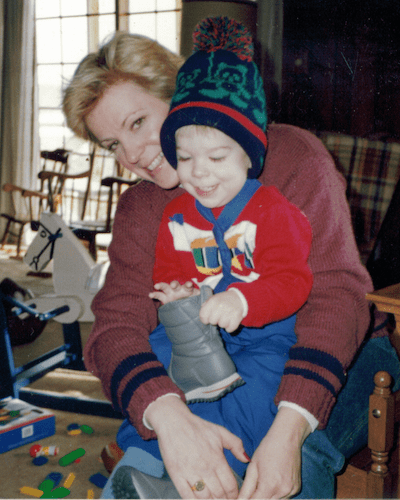
Watching her waste away from an aggressive form of uterine cancer – from diagnosis to deathbed in 10 months – was the most brutal thing my family and I have endured.
Losing her hurt. But I wasn’t prepared for what came after – a different kind of suffering entirely.
I lay awake at night, thinking about the experiences she’d never have. She’d never open her bakery. She’d never meet her grandkids.
And when I looked at my family, I saw her as the best of us. Here I was, a freewheeling degenerate – drinking, partying, contributing very little to society or the people around me (at least, that’s how I saw myself).
Now she was gone. And I was still here to…what? Continue down this “nothing” path of mine?
Was this just how life was? Or a cosmic-level fuck-up?
It was around this time that I first came across Viktor Frankl’s Man’s Search for Meaning.
It shifted my entire way of thinking.
In an obvious sense, nothing puts your own suffering into clear focus like hearing a man’s story of survival in Auschwitz. But in a more practical sense, Dr. Frankl’s book wasn’t just a recounting of camp life. It had a through-line – how suffering has not only the power to destroy, but also to transform.
He was a better person for having survived the atrocities committed by the Nazis.
Could I become a better person through the experience of losing my mom?
MAN’S SEARCH FOR MEANING

Author: Viktor Frankl
Published: 1946
Length: 184 pages
Buy: https://amzn.to/4rckUwu
WHY THIS BOOK MATTERS
Viktor Frankl was a psychiatrist and neurologist who survived Auschwitz. He’s a man who lost everything—his wife, parents, brother, all the way down to the unfinished manuscript of his first work in the concentration camps. As the founder of logotherapy – a practice that insists that meaning is the central motivational force in human beings – he anchored his camp experience through the lens of a psychotherapist.
When I read it, I was searching for meaning – it might have been the first time I’d found a book whose title promises to address the exact issue I was wrestling with. Meaning. Why I’m here. Big topics that I was not equipped to handle on my own. This book helped me in ways that made me emotional re-reading it preparing to write about it now.
Spending the bulk of my career in recruiting, I see it all the time – people stuck in an existential vacuum, struggling to find meaning in their work. I saw it with my mom, dying with her bakery dream inside her. It’s the motive power behind my building of the 2nd Act Protocol, designed for people waking up somewhere between 35-50 and realizing they’re unfulfilled. I can’t think of a greater pain than dying with unfulfilled dreams, and my goal is to help as many people as possible avoid that fate.
Life is not a quest for pleasure or power, but a quest for meaning.
If you don’t have meaning, you won’t build anything that outlasts you – you’ll just survive until you don’t anymore. This book helps you find meaning even when circumstances seem hopeless. And being written by a concentration camp survivor, it eliminates 99% of the “yeah, but I have it worse” cries.
THE ESSENTIALS: 3 CORE IDEAS
1. You Need a Future Worth Suffering For
My mom’s dream was her bakery. Frankl held on to the manuscript he needed to rewrite. We all need something that keeps us going when shit gets hard. Because shit always gets hard.
Frankl saw it in the camps. “Any attempt to restore a man’s inner strength had to point out to him a future goal.”
He saw it in suicidal prisoners – the ones who kept going had a child waiting for them, or an unfinished book series. The prisoners who lost faith in their futures were doomed. One of Frankl’s visions that kept him alive was him imagining lecturing about camp psychology after liberation.
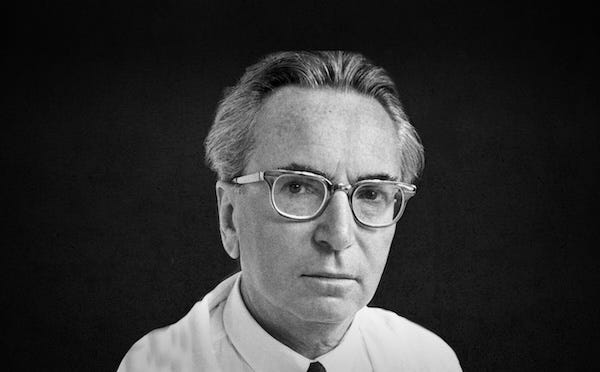
His key insight? “Suffering ceases to be suffering when it finds meaning.”
You’re not going to eliminate suffering in your life – don’t bother trying. Your goal is to have something that makes it worth enduring. Nietzsche said it the century before Frankl experienced it: “He who has a Why to live can bear almost any How.”
Most people stay stuck because they’re trying to escape their pain. I’ve seen it throughout my recruiting career. The better part of two decades watching people stay stuck in meaningless work. The ones who stayed miserable had nothing pulling them forward. The ones who made moves and took chances had a clear vision of what they were building toward.
The question shouldn’t be, “How do I stop feeling unfulfilled?” Instead, you should be asking yourself, “What future am I building that’s worth this discomfort?”
Your goal won’t eliminate suffering, but it will imbue it with meaning. Every hard day becomes a day you endured FOR something.
2. Life is Questioning You: Stop Asking What You Want
Most of us get tripped up here, asking ourselves, “What do I want from life?” That’s irrelevant. Life doesn’t give a shit what you want. So stop asking. Instead, listen to the question you’re actually being asked: “What does life want from you?”
If you’re not sure what you want, believe me, you’re not alone.
Frankl’s studies saw that 60% of American students felt “inner emptiness” or “a void within themselves.” They suffered from “Sunday neurosis” – a depression that kicks in when the busy week ends and emptiness becomes visible.
To get yourself out of it, you need to shift your thinking. Stop sitting in the paralysis that comes with asking yourself “What should I do?” Life is already asking you questions through your unhappiness and dissatisfaction. Feeling bored at work? That’s the question. The moments you feel most alive? That’s your answer. The more you close that gap, the more your unhappiness will dissipate.
Everyone has his own specific vocation or mission in life to carry out a concrete assignment.
You find your answer by moving, not by contemplating all of your options until you’re paralyzed.
If you need help sorting out where to start, a simple exercise is to “track the void” for two weeks. When you’re feeling empty or hopeless, write it down. When you’re feeling alive and excited, write that down, too. Over the course of a couple of weeks, the patterns will begin to reveal what life is quietly asking you to become. From there, it’s your responsibility to act.
Stop waiting for clarity about what you want. Start listening to what your life situation is demanding of you. The question you’re avoiding is the question you most need to answer.
Your emptiness isn’t the problem. Ignoring what it’s telling you is.
3. You’re Free Right Now. Choose Your Response.
If you’re in my stage of life – spouse, kids, mortgage, endless social commitments – you can feel trapped. But you’re not as trapped as a victim in Auschwitz. Frankl lost everything in his life and was still free.
Forces beyond your control can take away everything except one thing: your freedom to choose how you will respond.
Even in a concentration camp, prisoners could choose their attitude. There were people who gave away their last piece of bread to a comrade, or shared a blanket, or took a beating to protect a friend. The guards could attack and threaten death at every turn, but they could not strip a person of their choice of how they would respond to the moment.
You’re not trapped by your circumstances. You’re trapped by believing your circumstances determine your response. If people under constant threat of death could choose not to be victims, so can you.
Your job doesn’t make you miserable. Neither does your boss.
How you respond to your job, or your boss, is what’s keeping you unhappy.
Which means you can change your response now. Today.
You can transform through suffering. The suffering itself is neutral. Your response is what gives it meaning.
Every day you don’t take action, every day you choose to stay stuck in the discomfort – that’s you choosing to remain in that state of mind.
In the end, we’ll all have one last question to answer – one that many in Auschwitz had to answer far earlier than they expected.
How will you meet your death? Proud of the life you lived? Filled with regret?
Ask yourself the question now, as if today were your last.
And if you don’t like the response, start doing the work to make sure your final answer is one that reflects the meaning of your life.
THE ENDURANCE FACTOR
This book was written in 1946 and has sold over 16 million copies. It’s still selling.
It’s because the core truth doesn’t change: humans need meaning more than comfort.
Every generation has an existential vacuum, it just manifests in different ways. So ignore the circumstances and focus on the skills you can develop – skills that compound:
Finding meaning in what you create
Finding meaning in who you love
Finding meaning in your response to suffering.
I’ve returned to this book many times since I first read it. Anytime I’m feeling lost, directionless, or trying to make sense of my current situation. Anytime I’m wrestling with cosmic injustice. Anytime I’m taking on a new challenge, and need a philosophical framework to remind me why it’s worth the effort.
Because it’s our “why” that powers everything else in our lives. It’s how we endure when things are difficult. Why we don’t quit when everyone else would.
And it’s how works that outlast their creators are born.
Like this book. Frankl passed away nearly 30 years ago, but is still helping the lost and directionless today.
We should all strive to leave that kind of impact.
Thanks for reading. You’re part of a small (but growing), ambitious group who are striving towards something—a career move, an entrepreneurial venture, a 2nd act.
If you like this, subscribe to get these in your inbox.
Or follow me on LinkedIn, where I talk about building your 2nd Act without burning down your 1st.