

“Seriously? You’re turning it down?”
It’s 2020. I’d been with my company for years, promoted multiple times, and had a gold star next to my name. But the big job I was striving for had been hanging out there for six months, a carrot being dangled, as I continued to “grow into the role.” And I knew I was ready.
So I started taking calls.
One of them ended up clicking. It was for the big job at a bigger company. My potential future boss thought I was ready, too.
The offer came.
Bigger money than I had ever made in my life.
Pre-IPO equity – the kind that could change my family’s trajectory.
But there was something in my head telling me it wasn’t right.
My rebellious voice, the one born with a visceral disdain for the safe path. And when decision-time came, that voice’s whispers had become a stern warning:
“Come on, Radice – you know this ain’t it. Stay the course. You see the road ahead. And that side thing you’re working on? It’s starting to take shape.”
So I turned down the offer.
The recruiter couldn’t believe it. “Seriously? You’re turning it down?”
The hiring manager told me he was “gutted.”
And, returning to the current job on Monday morning, I thought to myself, “What the fuck did I just do?”
But my outlaw voice had it right.
The guy who would have hired me? I saw him celebrate the move to a new company on LinkedIn a month later.
And the company I stayed at? The big job came a few months later. The bigger money came. I grew into the leader I needed to become, all while quietly working on the craft that would come to define my second act.
That rebellious voice lives in all of us. The outlaw. The renegade. The person who wants to flip the bird at the system because they weren’t consulted when the goddamn rules were made.
Oscar-winning actor Matthew McConaughey details how he learned to listen to his inner voice in his nontraditional memoir Greenlights.
It’s genuine. It’s undeniably him. And if he was telling you this story on the barstool where you were grabbing dinner, you’d be shocked when the lights came on at last call, hoping he could squeeze in the ending before they tossed your ass outta the bar.
GREENLIGHTS
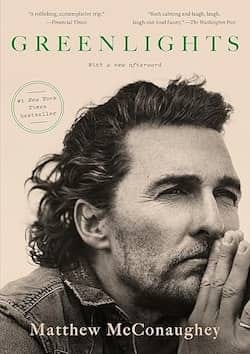
Author: Matthew McConaughey
Published: October 20, 2020
Length: 320 pages
WHY THIS BOOK MATTERS
Greenlights isn’t your typical celebrity memoir. It’s 35 years of journals distilled into outlaw philosophy, a handsome Texan who rom-com’d his way to superstardom, then walked away from it all to become the actor he wanted to be.
I picked this up when it came out – during the COVID pandemic. We were all at a crossroads, all looking for safety, all suppressing our inner outlaws. The first time through, I saw it as a fun read by an excellent storyteller. But certain ideas kept bubbling back up from my subconscious at different decision-points in my life. So I revisited it now, half a decade older, hopefully a little wiser, to see if it made the cut. And what did I find?
This is the blueprint for the second act pivot. Not the sanitized version—the real one, where you have to earn the right to break the rules before you break them, and when you do break them, you’re paying a steep price today for a better day down the line.
THE ESSENTIALS: 3 CORE IDEAS
1. Outlaw Logic: Master The Rules Before You Break Them
McConaughey was raised on what he calls “existential outlaw logic.” His parents divorced twice and married three times—to each other. In his house, if something wasn’t true, it ought to be.
His dad’s philosophy was simple: “You better follow the rules until you’re man enough to break ’em.” You got your ass whipped for breaking rules, but you got punished worse for getting caught.
At 18, McConaughey went to Australia as an exchange student. The Rotary Club wanted him to sign a contract promising not to come home early when the homesickness inevitably hit. His response?
“I’m not signing that paper, but I’ll shake on it.”
Handshake over contract. His word was the deal. When things got brutal—and they did, in some bizarre ways—he stayed the full year. Not because of a paper, but because he shook on it, and that handshake meant something to him about who he was.
You might read outlaw logic and think “chaos,” but you’d be mistaken. It’s earned rebellion. You prove you know the game well enough to know when the rules are bullshit. Then you break them with integrity – an integrity you define for yourself.
You can’t pivot successfully if you never mastered your first act. The outlaw move only works when you’ve earned the credibility to make it. McConaughey didn’t walk away from rom-coms on day one. He dominated them first. Then he burned the bridge.
2. “Don’t Half-Ass It”—The Only Permission That Matters
As the best debater in the household, McConaughey was groomed to be the family lawyer. Blue-collar family from Texas with a few failed lawsuits under their belt, he was ready to play the part, and enrolled at University of Texas in the pre-law program.
But at his core, he knew it didn’t feel right. What did? Film school. Telling stories (like this book, which is a masterclass in barstool storytelling).
So he did what any 18-year-old in college would be scared shitless to do: he decided to call his dad and break the news.
At 7:36pm, after he knew dad would be fed and have the first drink in his bloodstream, he phoned home.
“Dad, I don’t want to go to law school anymore. I want to go to film school.”
Five seconds of silence.
“Is that what you wanna do?”
”Yes sir.” No hesitation from the kid taking the reins of his life.
Another five seconds.
“Well… Don’t half-ass it.”
Of all the things his dad could’ve said—disappointment, concern, “are you sure?”—he gave him the only permission an outlaw needs: total commitment.
Not “good idea.” Just “if you’re doing it, fucking do it.”
McConaughey took that seriously and won big. After exploding with “A Time to Kill,” he ended up getting typecast in rom-coms. Shirtless guy on the beach, working with the sexiest women in Hollywood, printing money. Living the dream, right?
For a time, yeah. But then the work became automatic. All challenge disappeared. And he started to hear it again – the quiet, insistent voice that he needed some more resistance in his life.
“I was more alive in my life than in my movies.” Sure, that’s the balance all of us would want if we could only settle for one or the other. But who says we have to settle?
So he turned down rom-com after rom-com in search of challenging dramatic work.
One studio offered $5 million. He passed.
$8 million. Nope.
$10 million, $12.5 million, $14.5 million.
(Well, he re-read the script at $14.5 million. I think we all would. That’s a ton of cash to do something you can do in your sleep.)
But in the end, he passed. And industry finally got it: he wasn’t rom-com guy anymore.
Twenty months. Zero work. His agent stopped hearing his name. Hollywood forgot him.
With their firstborn infant in her lap, his wife Camila backed him up: “If we’re gonna do this, we’re gonna do it all the way. No half-assin’ it.”
So he waited. He questioned himself. He looked at alternate vocations – the world always needs more teachers, right?
But as the months passed, the conversations in Hollywood shifted:
“Holy shit, this guy’s committed. Nobody turns down that kind of cash. He must have a plan.”
Then: “What’s McConaughey up to? He might be a unique choice for…”
The offers that came nearly two years later? Lincoln Lawyer. Killer Joe. Mud. True Detective.
His take on it? “I was remembered by being forgotten.”
He became a novel idea by disappearing. How he drew it up? Maybe, maybe not. But it worked because he didn’t falter – even when studio execs threw NFL money his way.
That’s the move. Not hedging. Not keeping one foot in. Go all in, or don’t bother.
3. The Greenlights Come When You Stop Asking
McConaughey got offered the role of Van Zan in Reign of Fire as a dragon-slaying badass. He shaved his head for the character (also because he was losing his hair—outlaws aren’t exempt from the global curse of the balding man).
The studio executive called: “You did NOT shave your head.”
“Yes I did.”
The exec then sent a letter: “This would be a tragedy… it may bring you very bad karma.”
The threat was meant to make him back down. Instead, McConaughey bought a custom Gucci suit, tanned his shaved head by the pool for five days until it was bronze and shiny, then showed up to an industry party looking like a goddamn Greek statue.
Executive called Monday: “I love the shaved head! You look original!”
But the real proof came with Dallas Buyers Club. He was attached to the script for five years. Nobody would finance it with him in the lead. Even his agent told him, “There is NO movie, Matthew.”
McConaughey: “We’re shooting in October.”
He lost 47 pounds on faith. Still no money.
“We didn’t ask permission. We didn’t flinch. We took the hill.”
Someone finally put up $4.9 million (they needed $7 million). They made it in 25 days. He won his first-ever Oscar for Best Actor, fulfilling a lifelong goal.
Nobody validates your outlaw path. That’s your job – to sign on the line for the decisions that will define your life. Your greenlights appear when you stop waiting at someone else’s intersection and start moving.
THE ENDURANCE FACTOR
This isn’t McConaughey’s invention—it’s ancient outlaw wisdom. Your dad had it. His dad had it. I strive to live so that my kids remember me having it. Every generation has the outlaws who create their own greenlights and the rule-followers stuck at yellow lights.
The book’s been out since 2020 and it keeps resonating because the pattern doesn’t change:
Master your craft
Go all in on the pivot
Stop asking permission
Twenty years from now, someone will read Greenlights during THEIR crossroads moment and realize: the greenlights were always there. They just needed the balls to stop asking and start taking.
The bottom line: Outlaw logic isn’t about being reckless. It’s about being relentless. It’s about earning the right to break the rules, then not half-assing it when you do.
More outlaw = more greenlights. Not because you’re breaking rules—because you’re playing by your own. And at our peak, that’s the best any of us can hope to do.
KEY QUOTES
These are the ones I wrote down: no commentary needed, you can hear him saying every line – even the ones that aren’t his.
“Style is knowing who you are, what you want to say, and not giving a damn.” — Gore Vidal
“One in a row. Any success takes one in a row. Do one thing well, then another.”
“I have never had any trouble turning the page on the book of my life.” — Darryl K Royal
“I never wrote things down to remember; I always wrote things down so I could forget.”
“It is not about win or lose, it is about do you accept the challenge.”