

“I guess I’ll be caught up when I’m dead.” - Me
And you. And your spouse. And your boss, your grown kid, your neighbor, and anyone trying to live in the diluted-attention economy that is 2025.
Need proof? Check the state of your “unreads” at the end of the night. Mine:
Personal email: 52 unread.
Work email: 332 unread.
Side-hustle email (mostly newsletters and coaches promising to help you grow): 2,847 unreads.
Texts: 15 unread.
WhatsApp fraternity chat: 33 unread (150+ if it’s Monday Night Football).
LinkedIn: 25 unread.
The sick joke? Most of my days are really productive.
I crush tasks. I move the needle at work. My house isn’t falling apart. My family feels loved and supported. I get shit done (like writing this newsletter) and feel good about what I’m doing.
Yet I’m always behind.
And always will be.
Oliver Burkeman’s Four Thousand Weeks does the math: on average, that’s how long we all get. If that sounds short to you, it’s because it is. And on the scale of recorded history, our existence equals the flash of a camera in a dark room.
And when you realize that, in the long run, we’re all dead (killer opening chapter title, pun intended), something funny happens:
You breathe a little easier.
Those emails seem less important.
You don’t care if you miss the fundraiser.
You’re fine letting those “we should catch up soon!” notes drift into their deserved oblivion.
In an age of productivity advice, this book is the anti-productivity guide high performers need. Because being productive is not about your new system, timer, or app.
It’s about making the time to do the things that really matter, then being present for them.
Because, if you’re reading this, you have less than 3,000 weeks left.
FOUR THOUSAND WEEKS: TIME MANAGEMENT FOR MORTALS
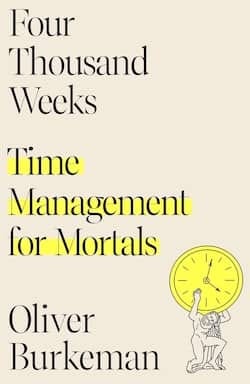
Author: Oliver Burkeman
Published: August 10, 2021
Length: 290 pages
WHY THIS BOOK MATTERS
Confession time: I’ve done the productivity geek thing. I buy notebooks like finding the perfect one will solve all of my problems. New AI tool to improve my efficiency? Signed up for it, canceled the next month. Weekly / monthly / quarterly goal tracker? I had my friend in the UK grab me a copy of a notebook I couldn’t get in the States.
Guess how much it helped me get done? How many of those systems are still in operation? Hint: I’m writing this on a brand new app I downloaded today…
My quest hasn’t ended. Just like yours probably hasn’t. Getting on top of our to-do lists will always be one app away, just over the horizon.
Here’s why Burkeman gets it: He was a productivity columnist for The Guardian who spent years testing every time management hack. Then had the same realization I did: It’s all bullshit. Not because the tactics don’t work, but because they’re solving the wrong problem.
The real problem? We’re not trying to manage our time. We’re trying to avoid the uncomfortable truth that we’re mortal, limited, and fundamentally not in control. Every productivity system is just a more sophisticated form of denial.
THE ESSENTIALS: 3 CORE IDEAS
1. You’ll Never Be Caught Up—And That’s The Point
Burkeman discovered something that should be obvious, but isn’t: The better you get at email, the MORE email you get. It’s not a bug. It’s a feature.
Edward T. Hall’s metaphor for this is perfect: Time feels like a conveyor belt bringing you tasks. The more productive you get, the faster the belt moves. You don’t end up failing at productivity – you succeed yourself into exhaustion.
This was studied by Ruth Schwartz Cowan in relation to washing machines (or, as Michelle calls them, “the bane of her fucking existence.”) When washing machines were invented, laundry didn’t take less time—standards just got higher. Now we wash clothes after we wear them once instead of when they smell. Every hour you ‘save’ just get filled with new demands.
So what does that mean for all of us hanging on to a fantasy? You know the type:
“When I finally get the workload under control…”
“When I get promoted…”
“When I finally have enough money saved…”
It’s all the same lie: That someday, you’ll have arrived. In reality, when you arrive, you’ll be handed more tasks…and again feel like you need to catch up. To quote one of my old executive partners, “It’s like a pie eating contest where the prize is more pie.”
I liked the highlight of Hofstadter’s Law: Any task takes longer than you expect, “even when you take into account Hofstadter’s Law.” Time actively resists your attempts to control it.
Burkeman’s tactical shift? Approach your work with a fixed volume. You’re only going to do so much. It’s a vast mental shift from how I typically approach my work, which looks more like, “I’m done when I collapse onto my keyboard.”
He recommends keeping two lists:
Open list (the nightmare – everything you need to get done in all areas of your life).
Closed list – The 10 tasks you’re working on right now.
You check something off the Closed list, you can add something from the Open list. But you can’t add to Closed until something’s done. This allows you to decide in advance what you’re going to fail at. If “drop 20 pounds” is on the Closed list and “Keep the kitchen clean” is on the Open, so be it. You’re gonna stare at dirty dishes more frequently and concentrate on the scale.
2. Your Attention is Your Life (And it’s Under Siege)
Here’s some tough math: We can consciously attend to about 0.0004% of information bombarding our brains at any moment.
But attention isn’t just some resource you manage—it IS your life. As Burkeman puts it: “Your experience of being alive consists of nothing other than the sum of everything to which you pay attention.”
Sit with that for a second. Your life is literally made of what you pay attention to. Nothing more, nothing less.
Meanwhile, every time you pull up Instagram or TikTok because you’re bored, “there are a thousand people on the other side trying to keep you there.” An army of PhDs and engineers focused on one mission: dwell time. Keep you on the platform. You think these people give a fuck about your mental health? It’s capitalism, baby.
If you’re a human being, it gets worse—you’re their accomplice. Because deep down, we all WANT to be distracted. Mary Oliver called it “the self within the self, that whistles and pounds upon the door panels.” We seek distraction because focusing on what matters is uncomfortable. It forces us to confront our limitations, our mortality, our fundamental lack of control.
Remember when 3 million people watched BuzzFeed wrap rubber bands around a watermelon for 44 minutes? Not because it was compelling. Because it was easier than sitting with ourselves. (I didn’t catch that one, but I’ve burned plenty of hours on equally mindless shit – Homestar Runner cartoons come to mind.)
The cost isn’t just time. It’s reality itself. Every hour on social media warps your picture of the world, generates anxiety even when you’re offline, and trains your brain to crave the next hit.
The philosophical shift? Accept that the discomfort of focus is the point, not something to avoid. When it feels hard to stay present, that’s your brain trying to avoid the weight of being human. Because, yeah, it’s fucking heavy being a human. But the only way you can carry the weight is to get stronger – rep by rep.
3. Stay On The Fucking Bus
Photographer Arno Minkkinen gave his students this advice about creativity, but it applies to everything:
The Helsinki bus station has 24 platforms. Multiple buses leave from each platform. For the first several stops, ALL buses from the same platform follow the same route.
You start a project. Three years in, someone says you’re derivative. So you quit, start over. Same thing happens. You keep jumping buses, searching for your “original” work.
Minkkinen’s solution? “Stay on the fucking bus.”
Eventually the routes diverge. That’s where distinctive work begins. But it ONLY happens for those patient enough to endure the derivative phase.
In a world built for instant gratification, the capacity to resist hurry becomes a superpower. Jennifer Roberts makes her Harvard students stare at one painting for three hours. First 40 minutes: torture. Hour two: something shifts. You stop fighting. The painting reveals what you miss when you’re looking at it long enough for your iPhone camera to focus.
But my favorite part of this chapter is something I’ve been circling in a few areas of my life: cosmic insignificance therapy (thanks, Hormozi).
The universe is 13.8 billion years old. Human civilization? 6,000 years. That’s 0.00004% of cosmic history. You could fit all of recorded human existence into a single commercial break on the universe’s timeline.
In 4 generations, everyone who knows anything about your existence will be gone. Your hopes, fears, dreams, achievements – gone, just like you will be.
So why, exactly, are you so upset that your 2-year-old just colored your white fireplace stones with black sharpie?

In the right frame, how little anything we do matters in the scheme of the cosmos is more liberating than terrifying. Time’s undefeated – we all get a death prognosis the moment we take our first breath. It’s dumb that we fight it (by we, I mean I.)
Why run yourself into the ground justifying your existence with your achievements? Believing you need to “make a dent in the universe?”
How much of a dent can a blink really make?
So, what if preparing meals for your kids matters as much as anything could? What if your novel is worth writing even if twelve people read it? What if any career is worthwhile if it makes things marginally better for the people around you?
We don’t need cosmic significance. We need local presence. Stay on the bus. Accept you’re a speck. Then get to work on the only thing you can: whatever’s right in front of you.
THE ENDURANCE FACTOR
This book will outlast the usual productivity porn because it’s not selling you another system. It’s not promising you’ll ever feel “in control.” It’s offering something harder and more valuable: reality.
The fundamental truth: You have 4,000 weeks if you’re lucky. You’ll never get everything done. You’re not in control. You’re not that important.
And once you stop fighting those facts, you can start living.
The attention economy is getting MORE sophisticated, not less. AI will accelerate this, not solve it. The pressure to optimize will intensify. Which means people who can accept limitation will have an increasingly rare advantage.
This builds the skills that matter: Patience in an impatient world. Focus in a distracted world. Acceptance in a world built on denial. Presence in a world obsessed with the future.
And, if we’re fortunate, something more valuable than a skill.
Peace of mind.
KEY QUOTES
The day will never arrive when you finally have everything under control… and that’s excellent news.
Strategic underachievement is the only way to achieve anything meaningful.
Missing out on something—indeed, on almost everything—is basically guaranteed.
Hope is the opposite of acceptance; it keeps you leaning forward into a future that never arrives.
Reality is always this moment, which is never quite the one you had in mind.
Stay on the bus. The scenery changes.