


Most people don’t hit rock bottom.
They drift. They sedate. They comply.
They do everything the world tells them to do—and still feel empty. So they chase distractions, wrap themselves in comfort, and call it success. But deep down, they know the truth:
They haven’t felt anything in years.
That’s where Fight Club begins—and why it still matters.
This isn’t a book about violence. It’s about clarity. What happens when your identity burns to the ground—and you’re forced to rebuild from ash. It’s about questioning everything you’ve been taught to want. And finding out who you are when the masks and vanity metrics disappear.
FIGHT CLUB: A NOVEL
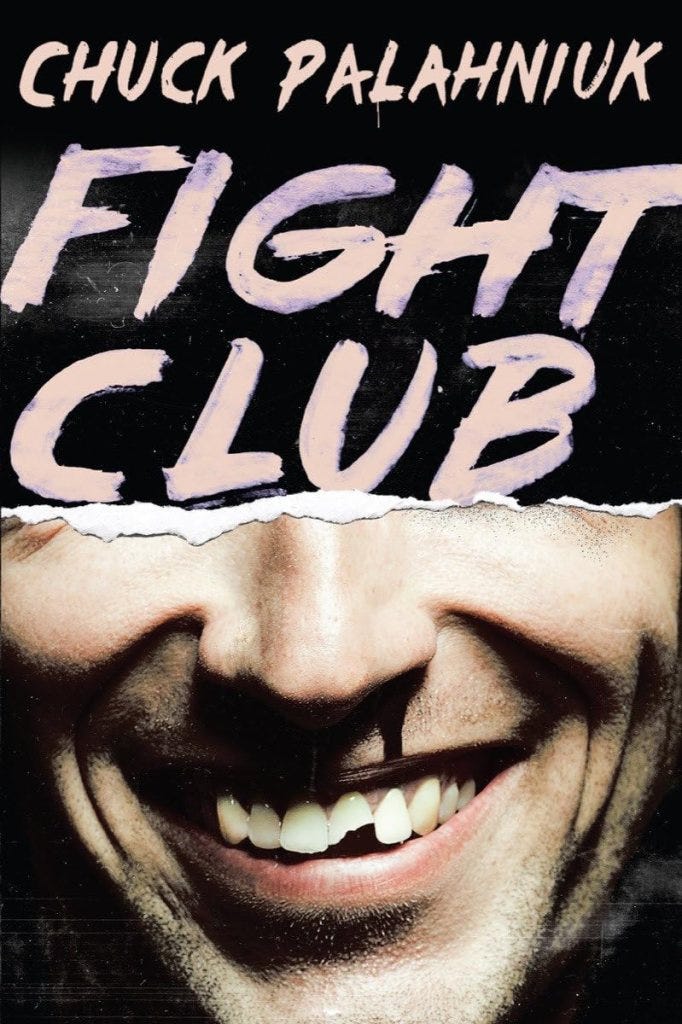
Author: Chuck Palahunik
Publication Date: August 17, 1996
Length: 224 pages
THE FOUNDATION
“The first rule of Fight Club is you don’t talk about Fight Club.”
“The second rule of Fight Club is you do not talk about Fight Club.”
Guess I’m breaking the first 2 rules today.
On the surface, Fight Club is a brutal, chaotic, sometimes disturbing novel about an underground fight ring that spirals into domestic terrorism.
But that’s not why it endures.
Fight Club survives because it speaks to the deep, unspoken despair of modern life—and offers a brutal form of liberation. It’s about a man who loses everything and finds freedom. Not peace. Not joy. But freedom—the clarity that comes after collapse.
This book doesn’t want to entertain you. It wants to wake you up. And if that means breaking you first, so be it.
[Note: Because the movie was flawlessly adapted from this novel, there are spoilers ahead. But it’s been 25 years since the film’s release- so if you haven’t seen it yet, it’s kind of on you. And how the hell did you miss it? Nobody told you about Brad Pitt’s abs?]
THE ESSENTIALS
DESCENT
The narrator begins as a cog in the corporate machine, living a life so comfortable it’s suffocating. By day, he’s a recall specialist in a suit; by night, he’s an insomniac haunted by the emptiness of his perfect, IKEA-furnished condo. Numbed and disconnected, he seeks a bizarre form of therapy: crashing support groups for diseases he doesn’t have. In church basements among actual survivors, he can weep and be held, feasting on raw human emotion – tears, sweat, the authenticity of pain – just to feel something. It works as a sedative for a while; this stolen catharsis lets him sleep again.
But then Marla Singer shows up – another faker invading his sanctuary of despair. She becomes a mirror to his lie, a black-clad ghost who reminds him that his emotional salvation is built on deception. With his coping mechanism exposed and ruined, the narrator’s insomnia and existential nausea come roaring back. He’s a man at the end of his rope, suffocating in the hell of a sterile, anesthetized existence and craving any form of escape.
The breaking point comes in flames. One day, his high-rise apartment blows up, obliterating every trendy possession that once propped up his identity. The life he curated – the designer furniture, the comfort and safety – is now a pile of smoldering ash. Homeless and stripped of everything that defined him, the narrator is strangely liberated by disaster. With nothing to lose, he’s primed for a radical transformation.
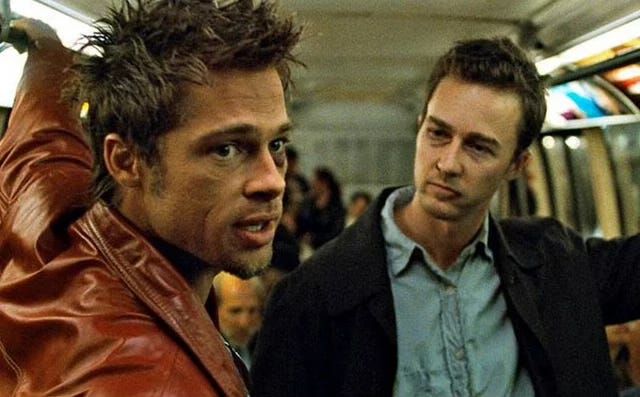
Enter Tyler Durden.
AWAKENING
Tyler Durden enters like a prophet of chaos—everything the narrator isn’t. Confident. Charismatic. Untamed.
They meet by chance, drink, talk—and then Tyler asks for something insane:
“I want you to hit me as hard as you can.”
The narrator throws his first punch, weak and misdirected. Tyler hits back hard. It hurts—and somehow, it helps. In that moment, they both feel something they hadn’t in years: alive.
That’s the birth of Fight Club.
Each weekend, men descend into basements to beat each other bloody. They’re not thugs—they’re waiters, mechanics, salesmen. The rules are crude. The fights are brutal. But the clarity it brings is undeniable. Pain becomes presence. Suffering becomes signal.
The narrator begins to shed his old identity—consumer drone turned primal creature. His body bruises. His mind sharpens. The fear, the comfort, the need for approval—gone.
Tyler’s philosophy takes root:
“It’s only after you’ve lost everything that you’re free to do anything.”
Through Fight Club, the narrator finally feels real. Under Tyler’s guidance, he embraces a new kind of freedom—chaotic, raw, and untethered from every lie he used to live. Tyler doesn’t just lead a movement—he rewrites the narrator’s reality.
But as the narrator follows deeper, the line between them begins to blur. And what felt like freedom starts to feel like something else entirely.
AFTERMATH
What started as underground catharsis becomes a full-blown revolution.
Fight Club morphs into Project Mayhem—a decentralized army of the disillusioned, following Tyler’s commandments and carrying out acts of destruction in his name. What was once about feeling alive is now about tearing the world down.
Then it gets real. One of their own dies during a mission – someone the narrator was close with from the support groups of his numb, insomniac past. The man’s name becomes a chant. “His name is Robert Paulson.”
The rebellion is no longer symbolic—it’s fatal.
And as everything is crashing down around him, this is when the narrator realizes the horrifying truth.
He’s not watching Tyler lose control. Tyler is him. He is Tyler – the architect of Fight Club, Project Mayhem, and all of the death and destruction that is soon to follow.
The final showdown between the narrator and Tyler takes place on a rooftop, bombs wired below. A gun in his mouth. Madness on both ends of the spectrum. He’s fighting not an enemy, but a projection—the darkest part of himself.
He pulls the trigger—not to die, but to kill Tyler. The bullet rips through his cheek. When he wakes, Tyler is gone.
Maybe the bombs worked. Maybe they didn’t.
It almost doesn’t matter. The chaos is over. But so is everything else.
He’s free now. But alone. No answers. Just the wreckage—and the quiet question:
When you destroy everything that held you back… what’s left?
KEY QUOTE
Most of the best lines of the movie are lifted from the book, so I’ll summarize with a few paragraphs that encapsulate the soul of the story for me (and highlight Palahniuk’s style and view of the modern condition that I came to love):
“You have a class of young strong men and women, and they want to give their lives to something. Advertising has these people chasing cars and clothes they don’t need. Generations have been working in jobs they hate, just so they can buy what they don’t really need.
“We don’t have a great war in our generation or a great depression, but we do, we have a great war of the spirit. We have a great revolution against the culture. The great depression is our lives. We have a spiritual depression.
“We have to show these men and women freedom by enslaving them, and show them courage by frightening them.”
This book resonates with me and what I’m about because I’ve found it true – for something new, you have to destroy what came before it.
Sometimes, personal revolution is violent.
Now, I’m not recommending you go out and vandalize cars or blow up corporate office buildings.
But don’t be surprised if the change you must make in your life requires a few new scars.