

My inner bitch has been whining a lot lately.
About how shitty the job feels when you’re holding the line instead of growing. About how uncomfortable the cold plunge is going to be when it’s 38 degrees outside. About how tired I am slogging through work early in the morning or late at night—work I dreamed up and put on my own plate. About how little time I have to get everything done.
He’s a master negotiator, my inner bitch.
Not mean—soothing. Cajoling. Finger-tapping my ego like Ed Van Halen on Eruption.
And the pattern is always the same: He points to something external. The constraints. The timing. The circumstances. Never me.
That’s the trap. Because once you let yourself believe the problem is out there, you’ve handed away the only power you actually have—the power to fix it.
I’m 40 now. I’ve fallen for this con enough times to know: the problem is never the circumstances.
The problem is me avoiding ownership of my part in them.
And the book that beat that lesson into my skull—the one that rewired how I lead, parent, and operate—is the same book I’ve handed out more times than I can count.
If you’ve worked with me since 2017, you’ve either been gifted this book or told to read it.
It’s my little black leadership bible.
Consider this me gifting you the interest - because, to be honest, you just need to read this one.
EXTREME OWNERSHIP: HOW U.S. NAVY SEALS LEAD AND WIN
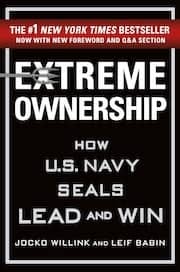
Authors: Jocko Willink and Leif Babin
Published: October 20, 2015
Length: 384 pages
Buy It Here: https://amzn.to/4pGwpvh
WHY THIS BOOK MATTERS
Jocko Willink and Leif Babin are former Navy SEAL officers who led Task Unit Bruiser in Ramadi, Iraq—one of the most decorated special operations units of the Iraq War.
They didn’t write a memoir. They wrote a leadership manual stripped down to raw essentials: No excuses. No passing blame. If something’s broken, it’s on you. Period.
The book is structured around battlefield stories followed by business applications. SEALs in urban warfare. Executives in boardrooms. The principles don’t change.
And the core message hits like...well, a SEAL: Leaders own everything.
Your team struggling? On you.
Project fails? On you.
Career stalling? Still on you.
This book forced me to stop pointing outward and start owning every result in front of me.
THE ESSENTIALS: 3 CORE IDEAS
1. Extreme Ownerhsip: The Problem Is Always You )(And That’s Good News)
Early in the book, Jocko tells the story of Hell Week boat crews. Six-man teams racing boats through freezing ocean water, sleep-deprived and broken.
One crew kept losing. Dead last, every race. The instructors swapped in a new leader—the best boat crew leader they had. Within two races, the worst crew became the best crew.
Same boat. Same guys. Different leader.
The lesson? There are no bad teams. Only bad leaders.
I’ve lived the inverse of this.
I moved halfway across the country for a job that was supposed to be my breakthrough. Before we’d unpacked the moving boxes, it was clear I’d been sold a bill of goods. Key details omitted. Market reputation worse than advertised. Uphill battle from day one.
I was fucking vexed. I blamed the owner for the bait-and-switch. The market for being hostile. Bad luck for the timing.
Which is, of course, bullshit.
If I had been crushing it—billing at the levels I was capable of—I would have been indispensable. Instead of letting these factors degrade my performance, I could have said, “Fuck it. Control what you can control and bill so much they have to change things to keep you.”
But I didn’t. I lamented the circumstances and buried myself in the process.
Extreme Ownership flips that script. The problem wasn’t the owner or the market. The problem was me not owning my part in the outcome.
So when I joined my next job—a scaling global tech startup—I went in with one mindset: Be so valuable they can’t get rid of you.
I owned everything. Never made things my boss’s problem. When I fucked up, I owned it. When I saw opportunities, I asked forgiveness instead of permission.
The result? Four promotions in six years. A 60-person team across 6 divisions and 13 countries. One throat to choke for global TA, supporting hiring in 80 countries.
Same person. Different ownership.
Once you own it, you can fix it. Before that, your best-case scenario is being saved by circumstances.
(Also known as “luck.”)
2. Prioritize and Execute: One Thing At A Time Or Everything Falls Apart
Jocko describes a firefight in Ramadi where everything was going to shit simultaneously. Gunfire from multiple directions. Wounded guys. Chaos.
His response? “Relax, look around, make a call.”
Not “handle everything at once.” Pick the highest priority. Execute. Move to the next.
In combat, trying to solve multiple problems at the same time gets people killed. In leadership, it just makes you ineffective and exhausted.
I learned this the hard way.
When I joined my current company, leadership instability was so bad that my default question in first 1:1s became: “So, what boss number am I for you?” (The highest answer? Eleven).
The people were incredible. But processes, systems, and tools all needed work. I saw all the opportunities at once—and launched projects to fix everything. Tiger teams. Travel to New York, Atlanta, and Madrid in six weeks. A year’s worth of initiatives crammed into months.
Unsurprisingly, I soon found myself underwater.
I had to tell my leader, “Well, I fucked up. I tried to do it all, and now I have six things pulling me in different directions.”
She got it. Together, we figured out glass balls (things that would break if dropped) versus rubber balls (things I could hand off or recover later). Then we stack-ranked everything.
That forced prioritization saved me. At my first performance review nine months in, I had delivered on all of it.
The lesson from Jocko and Leif: When you’re overwhelmed, the instinct is to attack everything at once. That instinct will destroy you.
Instead: Identify the highest priority. Execute. Move to the next. Repeat.
Chaos isn’t unique. How you handle it is.
3. Discipline Equals Freedom: Structure Is What Liberates You
SEALs live by rigid routines. Wake time. Workout time. Gear checks. Mission prep. The structure isn’t constraining—it’s what allows them to operate with flexibility when chaos hits.
Discipline creates freedom.
I didn’t understand this until I became a father.
Before kids, my life was reactive. I stole time for whatever I wanted—recording an album, hanging with my wife, drinking with buddies, playing video games. My life didn’t have structure. I wasn’t exercising regularly (see: was out of shape). I wasn’t chasing ambitions on a schedule.
When my oldest son arrived, the whole “discipline equals freedom” mantra I’d been ignoring for 4 years reared its head, unbeckoned from the sleep-deprived depths. If I wanted to be a good husband and father AND keep growing in my career AND release an album, I needed to lock in. Time blocks. Scheduled work nights. After the album, when I pivoted to writing, it was words on a page every day.
But the biggest shift came with three kids. That’s when I realized: “I’m about to be 40. When the fuck is this going to happen if I don’t do it now?”
I wanted to be a writer. Be in shape. Speak Spanish fluently. Be around for my kids’ graduations, weddings, grandkids. And I had the least amount of free time I’d ever had.
So how was I going to do it? Discipline.
Sacred hours every morning. Cold plunge every day. Spanish lessons every day. Writing every day.
The result? 40 pounds lighter. 462-day Spanish streak. Third draft of my book complete. Posting online 5x a week.
None of that happens without discipline.
THE ENDURANCE FACTOR
These principles will outlast us.
You’ll find echoes in Marcus Aurelius’ Meditations, James Clear’s Atomic Habits, David Goggins’ Can’t Hurt Me—because accountability never expires.
Most people dodge it. It’s uncomfortable.
But the ones who thrive—the ones who build high-performing teams, lasting careers, and resilient families—own every part of their lives.
Jocko and Leif didn’t invent extreme ownership. They just documented what’s always been true: The only thing you control is you. How you respond. How you lead. How you show up.
That doesn’t age. That doesn’t change.
This book made me a better leader, husband, father, and operator.
If you want better—read it, implement it, execute.