

In 2016, I was unconsciously vying for the title of Renaissance Man (and failing).
More directly: I wasn’t crystal clear on my vision, which left me doing a lot of different things to stay busy.
We had moved to Denver a year prior, which meant I had spent the prior 12 months acquiring new hobbies – snowboarding, hiking, camping, and sampling every Colorado-brewed IPA in an 80-mile radius.
These were just piled on top of the important things that already existed in my life: I was a husband, a dog dad, had a career I was trying to breathe life back into as I learned a new city, and a handful of songs written that I was aiming to turn into an album.
And, to the surprise of nobody other than the “Renaissance Man” flitting around the Rockies, adding inches to his waistline, I was making very little progress in anything.
My career was still stuck, despite legitimately working my ass off.
The songs were never quite done.
I kept getting myself in trouble on the mountains, having to use the ol’ falling leaf tactic to work my way down black diamonds like one of those lil’ ripper toddlers. (In truth, I watched toddlers pass me on those trails more than once).
Nothing was a priority, yet everything felt essential.
And while I was mildly annoyed, I wasn’t yet frustrated enough to change.
Michelle and I shot out to Vancouver for the wedding of a high school friend. She was in the wedding, so while my wife juggled bridesmaid commitments, I had the freedom to explore a new city. To belly up to a random bar on a Thursday afternoon and make a friend or two.
Instead, I sat in my hotel room with my Kindle and highlighted the fuck out of Greg McKeown’s Essentialism.
ESSENTIALISM: THE DISCIPLINED PURSUIT OF LESS
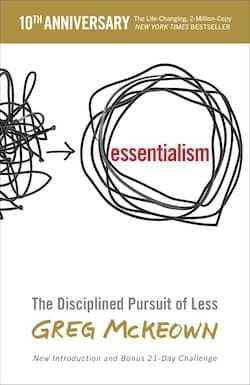
Author: Greg McKeown
Published: April 5, 2014
Length: 304 pages
Buy it here: https://amzn.to/4rppAzo
WHY THIS BOOK MATTERS
McKeown earned the right to write this by actually studying what worked. He spent years with Silicon Valley companies, watching some scale and others implode. The pattern was brutal and consistent: the ones who won weren’t doing more – they were doing less, but better.
I thought I learned this lesson in 2016. I got better at work. Started time blocking. Learned to say no graciously. Started asking “Is this essential?” before taking on projects.
But here’s what I’m realizing almost a decade later, rereading this with three kids under six and only 5-6:30 AM to build what matters: I applied Essentialism to my job. I never applied it to the rest of my life – including my dream.
2016 me had TIME. I had flexibility. I could have built 100x what I’m capable of now if I’d actually gotten serious about what I wanted instead of just getting better at what I was paid to do.
Now? Three boys, a global leadership role, and the quiet acceptance that I need to murder everything I can live without if I’m going to build anything that outlasts me.
THE ESSENTIALS: 3 CORE IDEAS
1. The 50% Buffer (or: Why You’re Always Wrong About Time)
Every time estimate you make is a lie.
Not because you’re dishonest. Because you’re human. And humans are systematically, predictably terrible at estimating how long things actually take.
McKeown’s solution is almost insultingly simple: multiply every time estimate by 1.5.
Always.
That presentation you think will take two hours? Block three. That newsletter you can definitely write in one sitting? Plan for two. Those sacred morning hours where you think you can knock out a framework AND respond to emails AND review your posts? Pick one.
At my best (which I’ll admit is infrequent), I use the 50% buffer. When I don’t, I end up writing my newsletter for 3 consecutive nights instead of the 1-2 sittings it should take.
Here’s why this matters for parents building in the margins: you don’t have time to be wrong.
If you’ve got 90 minutes before the kids wake up and you budget 90 minutes of work, you’ve already lost. The coffee takes longer to kick in. Your brain has to wake up and switch into “get shit done” mode, which feels like yanking a lawnmower starter cord until your shoulder’s burning.
But if you budget that 90 minutes as 60 minutes of actual work? You might actually finish something.
The 50% buffer isn’t pessimism. It’s refusing to lie to yourself about physics.
It’s also a forcing function. When you add 50% to everything, you immediately see you can’t do it all. You can’t fit seven things into your sacred hours if each of them actually takes 1.5x longer than you think. So you’re forced to choose.
Which is exactly the point.
Stop optimizing for the best-case scenario. Start planning for reality.
The best-case scenario almost never happens. Reality always does.
2. “Which Problem Do I Want?” Choose Your Hard.“WHICH PROBLEM DO I WANT?”
Trade-offs aren’t losses. They’re choices about which hard thing you prefer.
This is the reframe that changes everything.
Most people avoid trade-offs. They try to have it all. They straddle – McKeown’s term for keeping your existing strategy intact while simultaneously trying to adopt a competing strategy. It’s how Continental Airlines tried to copy Southwest to be both a low-cost carrier AND a premium carrier and ended up being neither.
It’s also how parents try to be fully present at home AND crush it at work AND build a side business AND maintain friendships AND stay in shape AND…
You know how this ends. Mediocrity on all fronts. Frustration and resentment across the board.
Essentialists ask a different question: “Which problem do I want?”
There are no solutions. There are only trade-offs. – Thomas Sowell
You’re not choosing between problems and no problems. You’re choosing between different problems.
Want to build something meaningful in the margins? Great. You’re choosing between the problem of “never getting traction on what matters” versus the problem of “dealing with FOMO and saying no to good opportunities.”
Want to be present with your kids? You’re choosing between the problem of “missing their childhood” versus the problem of “slowing your career trajectory.”
Both are hard. So pick your hard.
The power of “What problems do I want?” is that the question strips away the fantasy that you can avoid hard things. You can’t.
But you CAN choose which hard things you’re willing to tolerate.
And problems you’ve chosen are easier to tolerate than problems you’ve “let happen” to you.
3. If You Don’t Prioritize Your Life, Someone Else Will
Here’s the existential truth that should terrify you: every single day, you’re either designing your life or defaulting to someone else’s design.
The way of the Essentialist means living by design, not by default. Instead of making choices reactively, the Essentialist deliberately distinguishes the vital few from the trivial many.
And if you just let life happen to you, you’ll learn something quickly: other people are REALLY good at prioritizing your life for them.
Your boss prioritizes your life around their OKRs.
Your kids prioritize your life around their immediate (always fucking immediate) needs.
Your inbox makes everyone else’s urgency your problem.
Social media shows you all the experiences you “should” be having.
Society pushes you towards consumption and consumerism.
None of these are evil. They’re just optimizing for their goals, not yours.
If you’re not deliberately, systematically, relentlessly prioritizing your own life? You’re going to wake up at 45 with a calendar full of everyone else’s priorities.
And you’ll be fucking furious with yourself.
This hits differently for me right now, when I’m three weeks from launching my first digital product.
Because launching means I have to prioritize myself in a way that feels borderline transgressive. I am protecting my sacred hours. I’m saying no to good experiences and opportunities. I’m disappointing people. All because I’m choosing my life over other people’s expectations of my time.
I wrote out this Viola Davis quote and have been looking at it a lot lately:
“When it comes down to disappointing other people or disappointing yourself, choose other people all the time. Your job in life is to disappoint as many people as you can so that you do not disappoint yourself.”
THE ENDURANCE FACTOR
Essentialism will matter more in 10 years than it does today.
It matters more to me now than it did a decade ago.
We’re finite beings with infinite demands on our attention. That problem only gets worse. More tools, more platforms, more opportunities – all creating the illusion we can have it all.
The ability to discern what matters from what doesn’t isn’t a skill you’ll use once. It compounds. The earlier you develop it, the more years you get to spend cranking on things that actually count.
This book is for anyone who’s felt the gap between what they say matters and what their calendar says matters. For parents who want to be present without abandoning ambition.
Dare I say…for people building their second act without torching their first?
Thanks for reading.
I’ve been thinking a lot about what it means to build something that outlasts you while three kids under six are actively prioritizing every minute of my life.
It’s a brutal truth: you can’t build what lasts if you’re spending all your time on what doesn’t.
Once you’ve stripped away the non-essential, you need the ability to knock out focused work. Next week’s entry is the bible for getting shit done in a distracted world.
Until then—keep building, keep growing, and keep going.
Mike