


I LISTEN TO A TON OF PODCASTS.
They’re great background for the daily chores as my wife and I divide and conquer the Radice household operations.
My Notes app is always at the ready. But when I hear something that I want to capture, I have to:
Pause
Rewind
Pull up my Notes app
Hit play
Furiously type with my “slightly-too-thick-for-an-iPhone-keyboard” thumbs, butchering half of what I wanted to capture. Dammit.
Pause
Rewind
Get the rest of it right. (if not, repeat from “Dammit,” just escalate the swear word).
Then I go back to my chores—until the next nugget makes its way through the Bose earbud. Then, I need to pause, rewind, pull up my Notes app…
I learn a ton, but I can’t tell you how many times I thought to myself:
“Fuck, I wish this guy would just write a book.”
Well, one of them did.
Steven Bartlett’s Diary of a CEO podcast was the first UK podcast to reach 1 Billion views and listens. He brings on fascinating people from all walks of life who share their wisdom for our consumption. Some of the episodes are great. Others are duds. But if you sift through the thousand+ hours of content, there are incredibly valuable nuggets. So Steven did that, and distilled the advice into “33 Laws of Business and Life.”
I’ve distilled that further because, well, I assume that’s why you read these things. But this book was great. I read it twice in a month and gained even more insight on my third pass to compile this.
THE DIARY OF A CEO: THE 33 LAWS OF BUSINESS AND LIFE
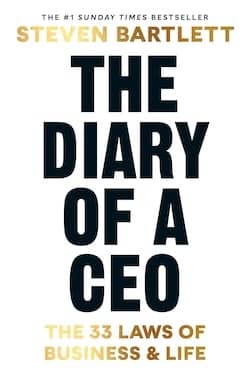
Author: Steven Bartlett
Published: August 29, 2023
Length: 368 Pages
WHY THIS BOOK MATTERS
You ever read a business book and think:
“Yeah… this was clearly written after the fact.”
The story’s too clean. The struggle is too polished. The author always ends up looking a little too clever.
Steven Bartlett didn’t do that.

The Diary of a CEO feels like someone cracked open a voice memo app mid-existential crisis—and then cleaned it up just enough to be useful.
It’s not about offering perfect answers. It’s about naming patterns you’re already half aware of—and pressing on the bruise until you finally do something about it.
33 laws. Four pillars. A lot of “damn, I needed that” moments.
What makes this book useful isn’t that it’s tidy.
It’s that it’s lived.
And if you’re trying to outgrow the version of you that’s playing it safe—or stalling out quietly—this book gives you something better than motivation.
It gives you a blueprint with bite.
THE FOUNDATION
This isn’t a book about building a company.
It’s about what happens when you try to build a life—and realize no one taught you how.
Bartlett isn’t handing you tactics. He’s handing you a mirror. And the reflection is a little uncomfortable in all the right places.
These 33 laws don’t follow the usual self-help script.
There’s no manifesting here. No flow charts. No “Just Be Yourself” energy.
Instead:
→ You sequence your priorities right, or you burn out chasing the wrong wins (Law 1).
→ You stop picking fights just to feel right, and start steering conversations like a pro (Law 3).
→ You realize good leadership isn’t consistency—it’s discernment (Law 32).
This book doesn’t offer balance. It offers recalibration.
It doesn’t offer hacks. It offers patterns.
It’s not self-help.
It’s a self-audit—with teeth.
And if you’re the kind of person who’s more comfortable fixing the thing than feeling the thing, this might be the book that slows you down just long enough to actually get better.
Alright—grab a drink, open your Notes app, and let’s hit the laws that actually stuck with me.
THE ESSENTIALS
Start with yourself—but do it in the right order. (Law 1: Fill Your Five Buckets in the Right Order) Most people chase wealth, then work, then maybe health—if they don’t burn out first. Flip it: health → relationships → learning → work → wealth. You’ll feel human again.
Teaching is how you learn faster. Or at all. (Law 2: To Master It, You Must Create an Obligation to Teach It) The fastest way to learn is to explain it like someone’s life depends on it. Because one day, it might.
You don’t have to win the argument. Just the outcome. (Law 3: You Must Never Disagree) You’re not playing for points. You’re playing for impact. Ask sharp questions, keep your ego out of it, and let someone else take the credit.
You won’t out-discipline your environment.(Law 8: Never Fight a Bad Habit) Willpower loses. Environment wins. Replace the habit. Don’t wrestle it.
That weird thing you do? That’s your edge. (Law 5: You Must Lean into Bizarre Behavior) Normal doesn’t get remembered. Quirky does. Use the weird—it’s usually where the value lives.
Be useful—but never boring. Law 10 (Useless Absurdity Will Define You) + Law 11 (Avoid Wallpaper at All Costs) Safe doesn’t scale. In a loud world, being slightly absurd is how people remember you.
Make someone uncomfortable. That’s how you know it’s working. (Law 12: You Must Piss People Off) Not gonna lie, I felt validated reading this one. You’re not trying to offend—you’re trying to matter. Polish is optional. Courage isn’t.
First five seconds. Every time. (Law 18: Fight for the First Five Seconds) Cut the intro. Lead with the line that punches in all areas of your life. If it wouldn’t make someone stop scrolling – or turn to talk to you at a bar – it’s not the opener.
Pressure isn’t punishment. It’s the invitation. (Law 24: You Must Make Pressure Your Privilege) Pressure means you’re playing for something that counts. You don’t escape it—you earn it.
Little things don’t stay little. Law 19 (You Must Sweat the Small Stuff) + Law 20 (A Small Miss Now Creates a Big Miss Later) Every “small exception” is a preview of a bigger problem. Precision now prevents chaos later.
Context > talent. Every time. (Law 26: Your Skills Are Worthless, But Your Context Is Valuable) You can be the most talented person in the room and still be irrelevant. Know the game you’re playing—and whether your skills actually apply.
The best leaders are inconsistent (on purpose). (Law 32: You Must Be an Inconsistent Leader) Different people need different playbooks. Treat fairness as equal investment, not equal treatment.
Stop asking how. Start asking who. (Law 28: Ask Who Not How) You don’t need to do it all. You need to find the person who can do it better—and get out of their way.
THE ENDURANCE FACTOR
What makes The Diary of a CEO endure isn’t just the clarity of the laws—it’s how they evolve as you evolve.
You’ll read this differently at 25 than you will at 45.
At the start of your career, you’ll underline Laws about self-discipline and identity.
Midway through, you’ll cling to Laws about pressure, context, and reinvention.
And when you’re in charge of building something bigger than yourself—your company, your team, your family—you’ll return to the Laws on teaching, leading, and asking “who, not how.”
You could spend 100 hours sifting through podcast episodes to get here.
Or you could keep this book on your shelf—and flip to the law you need right now.
This book is a mirror.
And the reflection changes every time you look into it.
KEY QUOTES
“If you win in the wrong order, you still lose.”
External success can’t fix internal misalignment. At some point, the trophies start to feel like proof you took the wrong path.
“You can’t outwork bad direction.”
Effort without aim is just expensive movement. Before you push harder, ask if you’re even facing the right way.
“You must out-fail the competition.”
It’s not about being the smartest. It’s about being the one still tinkering while others gave up – or didn’t take the risk in the first place.
“If you try to be everything to everyone, you become nothing to anyone.”
Stop sanding down your edges. You’re not here to be liked – you’re here to be known.
THE LEGACY TEST
This isn’t shelf candy.
It’s the kind of book you dog-ear, underline, and return to when something in your life stops working the way it used to.
You don’t just read it. You use it—to challenge your patterns, reframe your assumptions, and get honest about where you’re coasting.
It’s not a step-by-step plan.
It’s a sharp elbow, nudging you back to alignment.