

I have perfected the art of making pancakes with toddlers while simultaneously writing complicated AI prompts.
If that sentence sounds ridiculous, it’s because it absolutely is.
Michelle had a girls’ night away. I’d put the kids to bed solo the night before, then worked until 1 AM on my content strategy. Pancakes for breakfast were the incentive for the boys to stay in their rooms, and I’m a man of my word.
But I had fallen asleep (passed out?) before I had finished what I needed to do, and I was the only parent in the house, and I have a day job that I care about…so, my rationalization was that I needed to “maximize my productivity.”
This included being questioned by an AI interrogator while I supervised a 5 and 4-year-old mix flour, sugar, butter, milk, eggs, etc., with Bluey on in the background.
It wasn’t until later – when I saw how little progress I had actually made during my self-created breakfast chaos – that I asked myself the right question:
What the fuck am I actually producing right now?
The answer: trash.
Which always seems to be the case when I multi-task, split my attention, or try to serve two masters at once.
Ironically, I knew this approach was idiotic as I was doing it. I had just finished reading Cal Newport’s Deep Work, and knew that there were strategies and tactics for getting meaningful work done.
And to the surprise of no one, “getting pancake batter on your MacBook while your kids tell you to stop working” is not one of them.
DEEP WORK: RULES FOR FOCUSED SUCCESS IN A DISTRACTED WORLD
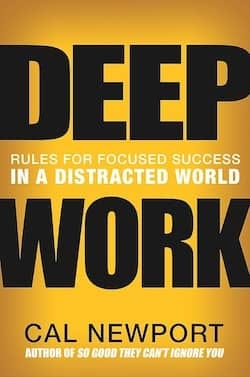
Author: Cal Newport
Published: January 5, 2016
Length: 304 pages
Buy It Here: https://amzn.to/3XREAbO
WHY THIS BOOK MATTERS
I’m glad this sentence appeared in the early pages, because it caught my attention and anchored the way I read the book this time around.
Hearing a succession of mediocre singers does not add up to a single outstanding performance.
Talent isn’t a commodity you stack. Neither is effort. You can’t combine six half-focused hours and call it three hours of real work. That’s not how any of this works.
Newport calls the real thing “deep work”—professional activities performed in a state of distraction-free concentration that push your cognitive capabilities to their limit.
The opposite is shallow work: the emails, the Slack & Teams pings, the meetings about meetings. Necessary, sure. But if that’s all you do, you’re replaceable. Sadly, those who’ve made their bones in the shallows are finding that out in real time, as AI munches through their inbox and spits out the few details that actually matter.
And that’s the point. The world is always changing, but the spread of AI has a “car replacing horse” kind of energy in its impact. It’s changing everything. And the people who are only capable of doing the work AI replaces are going to be the first to be, well, replaced.
Those who are going to come out on top of the global economic shift are going to be the ones who live in the depths, not the shallows. The ones who come up with the ideas, sit in silence until insights arrive, then leverage the new technology to make their “thing” happen more efficiently.
None of us can afford to ignore deep work if we still want to be relevant five years from now.
THE ESSENTIALS: 3 CORE IDEAS
1. Rhythmic Deep Work: The Only Strategy That Survives Real Life
Newport outlines several philosophies for building deep work into your life.
There’s the monastic approach—eliminate all shallow obligations, become a hermit. (Many days, this is my mental escape fantasy).
The bimodal philosophy alternates between periods of deep isolation and normal life. (Many days, this is my backup mental escape fantasy).
Then there’s rhythmic: transform deep work into a simple regular habit. Same time, same place, every day.
For anyone following my tagline of building their 2nd act without torching their first, rhythmic is likely your option. You’re not disappearing to a cabin to work uninterrupted hours at a time – what if the daycare app pings that your kid just threw up on the magna-tiles? If you’re lucky (like I was in 2022), you can take a sabbatical, but that time away tends to show you how much MORE you can be doing…just to drop you back into your regular life and force you to limit your options.
Life is getting the kids dressed, fed, out of the house, working the day job, trying to stay somewhat healthy by getting a workout or a walk in, and then the bracing for the kid’s re-entry that keeps you occupado until bedtime (including all the trips to walk them back to bed).
Cue: Jerry Seinfeld’s famous “don’t break the chain” method. He kept his comedy writing habit by marking an X on a calendar every day he wrote. The goal wasn’t word count or quality—just don’t break the chain. Show up, do work.
That’s why the rhythmic approach tends to be the way busy builders can get shit done. It’s why I write about sacred hours so often. I’ve read tons of biographies and how-to and self-development books (clearly, given the tone and topics of the newsletter), and this is one of the immutable laws of creation. Block time when nobody can bother you. Make yourself indistractable. Do it at the same time every day.
My Sunday morning pancake disaster happened because I was undisciplined and worked too late on Saturday night, causing me to miss my sacred hour window on Sunday. It was a structure problem.
Of course what I captured in between pancake flips and juice box delivery ended up being shit. And guess what? The stuff I did at 12:46 AM wasn’t all that fine, either.
We’ll all slip up and get ourselves out of rhythm. While Seinfeld is the ambition, James Clear’s advice is what I adhere to most: “Never miss twice.”
2. Embrace Boredom—or Keep Producing Nothing
If you’re constantly seeking stimulation, you’re training your brain against deep focus. Every podcast in the car, every scroll between tasks, every filled gap—you’re teaching your brain that boredom is intolerable.
His prescription? Take breaks from focus, not from distraction.
He also introduces what he calls “productive meditation”—using time when you’re physically occupied (driving, walking, showering) to work on a single problem. Not consuming content. Processing.
Until recently, I had it backwards. Every free moment had an earbud in: audiobook, podcast, tutorial. Walking, driving, sauna—always something playing. I was convinced this was how you learn.
Then a few weeks ago I got about 30% through a podcast and realized I’d listened to the entire fucking thing the week before on a different platform. None of it had stuck. Not a single concept.
I listened to the rest of the pod like Nate Bargatze watches history documentaries: on the edge of my seat.
After that, I forced some changes. No music when I’m journaling. Quiet car when I have a drive by myself. Walks without earbuds.
Sometimes, I hate it. I have FOMO over all the cool shit I could be learning if I just had the newest Modern Wisdom episode on. (Lately, it’s Dan Koe guidance about how to be better at the content creation game – and I got to listen to one of ’em twice).
But now, I keep a 2nd notebook next to my journal – it’s where I jot the ideas that pop up out of my subconscious. I transcribe my voice notes from my drives or walks and cannot tell you where the ideas came from. Sometimes it’s fun hearing yourself and saying, “Damn, I sounded pretty smart for a minute there.”
I’m only 3 weeks in, but this is the highest ROI I’ve had for any activity. Just by making a little space. The audiobook can wait.
(Related: this newsletter shipped a week late. So I’m still dialing in the new system).
3. When You Can’t Control the Boundaries, Control the Quality Gate
“Attention residue” may be my favorite takeaway from this book. It’s a simple concept that, for some reason, is not common knowledge nearly 10 years after publication. When you switch from Task A to Task B, your attention doesn’t follow cleanly. Part of your brain stays stuck on the previous task. This residue builds up and degrades your performance on everything.
It’s why you can’t get back into writing that email after you responded to your teammate’s DM. Or why you can’t fully lock into the KPI dashboard when your wife texts you, “Did you get the winter comforter down from the attic yet?” (No, it’s on the list, you only asked me to do it 3 weeks ago. Don’t rush me). Whatever just hijacked your attention sticks with you into the next task. You find yourself thinking, “Did I see the comforter when I was up there changing the air filters?”
Newport’s solution? A shutdown ritual at the end of each workday. Review what’s incomplete, capture what needs capturing, then completely disengage until the next morning.
It’s good advice. For some people, it’s even possible.
But for many of us—especially those leading teams across time zones or juggling day jobs with second acts—a clean shutdown isn’t realistic. I lead a global team. Pings come in during workouts and the evening rush. Those pings require attention later. And even when my phone is quiet, unresolved problems from work eat away at creative capacity.
On distracted nights, I can tell immediately—my writing is shit.
The skill I’ve developed isn’t a flawless shutdown ritual. It’s recognizing when attention residue is degrading my output. When the writing feels a little too much like a guy who just wants to go viral on LinkedIn. And when I catch it, I make a choice: perform surgery, toss it in the drawer for later, or trash it altogether.
I don’t publish mediocre work and pretend it’s good (though I post plenty of stuff I’ll cringe at 3 months later). That’s the line I can hold regardless of my schedule.
THE ENDURANCE FACTOR
Damn near everything created by the minds of humans has required deep work.
Books get written in focused periods. Swords get forged by craftsmen who aren’t checking notifications. Architects design buildings in stretches of uninterrupted thought. This isn’t new.
But the defense required to protect it is intensifying every year.
The world will only get more connected. AI might make parts of our jobs easier—or it might turn the two-lane road of information into a twelve-lane highway blasting content directly into our skulls.
Doesn’t matter. Whoever solves the next problem, paints the next masterpiece, finds the insight that changes everything—they’re doing it from a place of focus and concentration. Not from a kitchen counter with batter on their hands.
Newport puts it simply: “A deep life is a good life.”
Master this now. The demands on your attention aren’t getting lighter.
Thanks for reading. A bit of housekeeping (see: mea culpa):
I was planning on launching The 2nd Act Protocol on December 17th. That’s getting pushed for the same reason this entry was delayed – a great idea during a journaling session (embrace boredom, it works) that’ll 10x the value. Building it is scaring the hell out of me and stretching me outside of my comfort zone, but it is the way forward.
So, in the proud tradition of ambitious solopreneurs who’ve had to delay a release, The 2nd Act Protocol drops in the new year.
But I built something to give you now: The Golden Handcuff Diagnostic. A FREE, AI-powered PDF with killer prompts that’ll push you if you’re stuck, help you see what’s holding you back, and show you where you could be headed (the good and the bad).
Early results are promising:
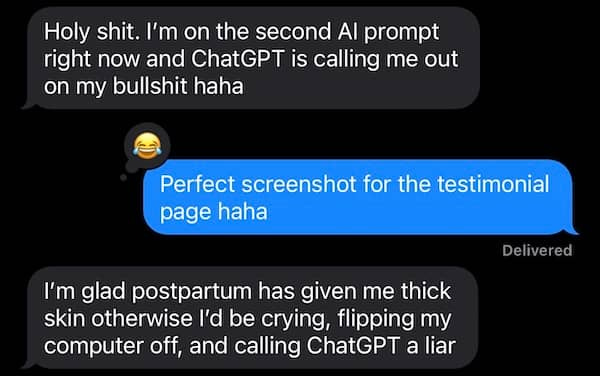
My hope is that this helps a lot of people. If you or someone you know is stuck, give it a shot. It’ll get you thinking about your life through a different perspective.
Next week, someone who’s had not one, not two, but three full acts in the public light…including the part where he blew up his family.
Until then—keep building, keep growing, and keep going.
Mike