

I GREW UP AS A CRAB IN A BUCKET.
You’ve heard of the phenomenon. Drop one crab in a bucket, and it usually claws its way out. But put a bunch in there? As soon as one hits the rim, the others will reach up, grab its legs, and pull it back down into the pile.
My immediate family has always been supportive of my efforts to better myself. But extending beyond the nuclear family, it was a mixed bag, to say the least. I had aunts and grandparents who had big dreams but failed to deliver on them. I had a mom who was an artist in the kitchen who refused to open her own bakery. One (toxic) branch of my family tree could be the dictionary definition of “playing small.”
I’m 40 years old and finally filtering through childhood baggage I ignored for decades. Some of that “playing small” mindset seeped into me as a kid, and I’m confronting it now. This version of me is building my 2nd Act while holding down a senior leadership job with a global team, trying to be a good husband, and raising three feral boys.
There’s nothing small about my life today.
And while the public comments might be supportive (especially on LinkedIn, where people are a bit nicer than the trolls on X or IG or risk losing their jobs), I’m in plenty of conversations that feel different.
Resistance. Skepticism. “Concern” that’s actually masking someone else’s insecurity.
Here’s what it sounds like:
“How do you have the time to do all of that? You’ve gotta be dropping something.”
“That’s a lot. It’s only going to get harder as it picks up.”
Or, the simplest (and most regular): “You’re fucking insane, man.”
I’m in my Lonely Chapter. It’s that long, quiet stretch where you’re breaking free from your old crowd but haven’t been invited into your new tribe yet.
And it’s also when, if you’re not careful, your mental crabs can drag you right back down into the bucket of your old life.
In circumstances like this, I find it helpful to default to action. Make decisions. Do shit. Keep moving. Be useful — and steal from people who’ve already escaped the bucket.
So I looked to a guy who’s had not one, not two, but three successful acts.
Surely, he figured some shit out.
BE USEFUL: 7 TOOLS FOR LIFE
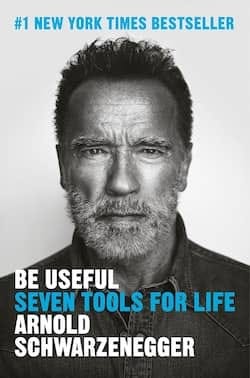
Author: Arnold Schwarzenegger
Published: October 10, 2023
Length: 288 pages
Buy: https://amzn.to/4baMncu
WHY THIS BOOK MATTERS
Yeah, it’s Arnold. It’s easy to write him off as the meathead action star or the “Governator.”
But look at the freaking scoreboard.
This man didn’t just have a career — he conquered three completely distinct, high-barrier worlds:
Bodybuilding: 7 Mr. Olympia titles. In the GOAT conversation.
Hollywood: Became the highest-paid leading man in the world (with an accent everyone said would ruin him and a name nobody can spell).
Politics: Ran California — the world’s 5th largest economy — through a financial crisis.
I picked this up because I wanted to know: What’s the through-line? How does someone pull off that level of reinvention — not once, but three times?
The uncomfortable answer is one that’s a recurring theme through my Outlast Yourself series:
You’re not stuck because of your circumstances. You’re stuck because your vision is foggy and your reps are low.
We love our excuses. “I don’t have time.” “The system’s rigged.” “It’s too late for me to start over.”
Arnold — who grew up in a house with no plumbing, with a physically abusive father, in post-war Austria — looks you dead in the eye and says: “Bullshit.”
If you’re stuck in your golden handcuffs, this book serves as a mirror…and a lock pick.
THE ESSENTIALS: 3 CORE IDEAS
1. Dream So Big It Embarrasses You (Then Sell the Shit Out of It)
Arnold’s first rule isn’t “have a vision.” It’s have a vision so big that saying it out loud makes you feel like an idiot.
A kid in a tiny Austrian village deciding he’s going to be a famous American movie star is fucking delusional. Full stop. But Arnold held that image with such clarity that every single decision filtered through it. The delusion became the compass.
But having the dream isn’t enough. As much as it might suck to hear for all the introverts, you have to become the Chief Sales Officer.
When Arnold came to America, bodybuilding was a fringe subculture for weirdos lifting in basements. He didn’t just compete — he became the ambassador. Wrote pamphlets. Traded magazine appearances for plugs. Controlled the narrative.
The hardest sale usually starts with the one in the mirror. You need to believe in this thing when nobody else does—because, for most of your journey, nobody else will. So even though your vision should (and will) scare the shit out of you, it’s your job to be all-in on its success.
From there, go public with it. When you tell people your goal out loud, you create a public commitment. Now your reputation’s on the line. Now you have to execute.
I spent months building in silence, convinced the work would “speak for itself.” It doesn’t. You have to sell the vision — to your spouse, your future customers, your mentors — until they see what you see.
The crabs in the bucket will try to pull you back. Your ambition holds up a mirror to their fear, and they don’t like what they see.
Your job isn’t to convince them. It’s to use their doubt as fuel.
And then put something in their hands that overdelivers on all of your talk.
2. No Helicopters to the Mountaintop
Arnold tells the story of Sir Edmund Hillary, the first climber to summit Mount Everest. Swarmed at base camp by reporters, he was asked if the view was amazing. His answer was that it was—because he saw other peaks he hadn’t climbed and was already thinking about the next route.
Then Arnold asks: Do you think anyone who helicoptered to that same summit would feel the same thing?
Not a chance.
He’s relentless on this — almost annoyingly clear: The hard work is the point. As Hormozi puts it, “Hard work IS the goal.” It’s not a necessary evil. It’s the price of admission for doing anything meaningful. The actual point.
He’s not romantic about it either. The work won’t be fun. It’ll be grueling and monotonous. You’ll want to quit. But reframe it: that discomfort is data—good data. It’s the signal you’re actually making progress.
I think about this constantly during my Sacred Hours.
5:37 AM. House is dark. I’m staring at a blank page, coffee going cold, trying to find the thread of an idea before my 2-year-old wakes up and the day detonates. It’s not glamorous, and there are no dopamine hits during this slog. It’s just me and the reps.
That perspective kills my patience for other people making excuses about why they can’t find time (especially healthy single people – you have no fucking idea how much time you have right now).
Arnold’s math on time is also confrontational (albeit more supportive): “You really can’t find an hour or two?”
He walks through his schedule as a young immigrant — bricklaying during the day, training five hours, acting classes, English classes at night. Running on fumes and still building multiple empires.
His answer to “I don’t have time” is simple: Stop lying to yourself.
If you’re not doing the work, you don’t want the goal badly enough.
And if you need more time? “Sleep faster.”
3. The “Self-Made” Man is a Myth
Arnold Schwarzenegger — the guy whose entire brand is built on self-reliance and iron will — says pulling yourself up by your bootstraps is bullshit.
Every step forward, he says, was made possible by someone else. The mentors who taught him to train. The people who gave him a shot in Hollywood. The voters who trusted him with California.
Nobody does it alone.
As a guy who doesn’t like asking for help, this one hit me in the chest.
The Second Act journey can feel incredibly isolating. You’re building something no one else can see yet. The Lonely Chapter stretches on way longer than any Instagram success story suggests. And when you’re deep in it, it’s easy to believe you have to figure it all out yourself.
But Arnold’s point goes further: receiving help creates an obligation.
Once you’ve been lifted, you lift others. That’s the deal.
He talks about his work with the Special Olympics, his charitable efforts. His view is that nothing in his career — not the titles, not the box office records — felt as good as being useful to someone else.
This reframes the whole project.
You’re not just escaping your golden handcuffs for you. You’re building a platform that lets you eventually reach back and pull someone else up. The person 30 steps behind you who just needs to see that it’s possible.
Being useful isn’t a soft afterthought to success.
It’s the whole point.
THE ENDURANCE FACTOR
This isn’t a book about hacks. It’s about physics.
Arnold’s whole philosophy boils down to something brutally simple: input equals output. Doesn’t matter if you’re building a bicep, a movie career, or a political campaign. The mechanics don’t change. See it clearly. Do the work. Sell it to the world. Use the rewards to help everyone you can.
That’s it. That’s the whole book.
No manifestation. No vision boards. No “attracting abundance” while you sit on your ass and wait for the universe to deliver.
You have to lift the heavy-ass weight. Arnold did it with barbells. Then with scripts. Then with legislation. The weight changes. The lifting doesn’t.
Fifty years from now, people will still be looking for shortcuts. And this book will still be sitting there, arms crossed, saying:
There aren’t any.
Thanks for reading. You’re part of a small (but growing), ambitious group who are striving towards something—a career move, an entrepreneurial venture, a 2nd act.
No fluff, no formulas, just fuel for the life you’re actually trying to build.
If this hit something real for you, it’ll probably land with someone like-minded who you care about. Send it along and help them out.
Follow me on LinkedIn for daily writing about ambition, parenthood, and the daily grind of building your 2nd Act.