

Learning Spanish helped me lose 40 pounds and become a better writer.
Last year in July, I went to Spain with Michelle for our 10th anniversary. Five days without ankle-biters needing snacks or entertainment—our longest escape in over 5 years.
We celebrated properly. Too much jamón, more vermouth than jamón. An “exercise routine” that peaked with one leisurely tour of Alhambra.
Back in Texas, I stepped on the scale and cringed. Heaviest weight of my adult life.
And the rest of my life wasn’t much better: online writing abandoned when it got hard, novel languishing in stops and starts, body falling apart with aches everywhere, and the cardio capacity of a sloth. I was married to a bilingual Spanish speaker, and despite “trying to learn Spanish” for years, I still couldn’t order coffee after a week in Spain.
So, where to start? Did I have the balls to tackle my health? My stalled writing career?
Nope. Took the path of least resistance.
I downloaded Babbel, bought a lifetime subscription to force commitment, and started learning Spanish. And one tiny feature in the app changed everything for me: the streak tracker.
Seven days in, I set a simple goal—don’t break the streak for a year. The minimum viable effort (a 2-minute vocabulary review) meant I could always keep it alive. But something else was happening. I was becoming someone who keeps promises to himself.
Once I saw that showing up daily could change my identity, I started applying it everywhere: working out 4 days and walking 3, writing for an hour daily, cold plunging after my fantasy football buddies dared me (nothing beats an ice bath after a sweaty Texas “fall” workout), adding sauna sessions because why not stack another habit.
On day 365 of my Spanish streak, I looked around at the rest of my life and was kind of shocked:
40 pounds lighter.
Four workouts a week paired with walking on the off days.
Cold plunging 6x a week, sauna 3-4x.
Third draft of my book complete, posting online 5x a week.
No hero effort. Just small stuff, every day, for a long time.
When I re-read Atomic Habits over the weekend, I kept saying “ohhhh” out loud.
I’d accidentally implemented damn near every tactic author James Clear teaches.
ATOMIC HABITS:
AN EASY & PROVEN WAY TO BUILD GOOD HABITS AND BREAK BAD ONES
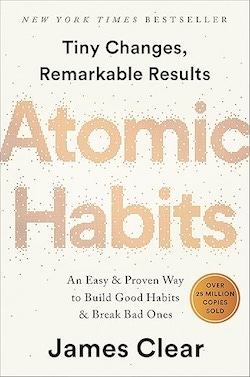
Author: James Clear
Published: October 16, 2018
Length: 320 pages
Buy it here: https://amzn.to/4oqxJkK
WHY THIS BOOK MATTERS
Clear earned his lessons the hard way.
He took a baseball bat to the face at 16 and ended up in a medically-induced coma. Upon waking, he had to rebuild his entire athletic life through small, boring habits that nobody noticed. That pattern helped him play college baseball, graduate with stellar marks, and start a newsletter that gained enough traction to warrant him writing a book about his findings.
I first read Atomic Habits in 2019—a time when my habits needed massive upgrades. But like most books, the lessons evaporated the moment I picked up the next one. Nothing changed.
(Perhaps the underlying reason I’m doing this series? A fair guess.)
Fast forward to this past weekend. I’m listening to the audiobook while staining my back porch stairs, and with every chapter I’m shocked at how much my subconscious retained.
Habit stacking. Environment design. Identity transformation.
All there in my life, implemented without conscious thought.
That’s when you know someone discovered something real: when their framework explains your accidental success better than you can explain it yourself.
THE ESSENTIALS: 3 CORE IDEAS
1: The Mathematics of Self-Destruction vs. Self-Construction
Clear gives you the math that should terrify anyone who’s honest about their trajectory:
1.01^365 = 37.78.
0.99^365 = 0.03.
The compound interest of getting 1% better every day for a year makes you 37 times better. The compound interest of getting 1% worse? You’re basically at zero.
What Clear doesn’t hammer home hard enough—and what my scale screamed at me—is that 1% worse happens with the kind of effortless momentum that would make physics professors weep. You can destroy months of progress in days without even trying. The slow drift toward becoming someone you don’t respect doesn’t feel like falling off a cliff. It feels like a vacation.
The Spanish app became my North Star, though not for the reason you’d think (after all, Michelle yells at me in English). The lessons became daily, accumulating proof that I was the person who does what he says he’ll do.
And once that identity started solidifying, the rest of my good behaviors started falling in line with minimal effort. Workout complete? Well, a cold plunge wouldn’t feel bad in this 102-degree garage. Morning pages written? Spanish lesson takes two minutes, let’s keep the momentum going.
Clear has great labels for all of these—habit stacking, temptation bundling, environment design. I had a simpler framework: might as well since I’m already sweaty. The chiller purchase for my cold plunge wasn’t some strategic environmental optimization. It was pure laziness—I got tired of hauling five 20-pound ice bags from the town ice machine like some kind of suburban Sisyphus.
But that laziness was the point. Make the right thing the easy thing. Remove friction from what you want to do, add friction to what you don’t. It’s not motivation, it’s architecture.
2. Motion vs. Action: The Mental Masturbation of Preparation
Clear draws a distinction that should be tattooed on every productivity junkie’s forearm: motion is not action. Motion is researching the perfect Spanish learning app for two weeks and watching YouTube videos about language acquisition theory. Action is downloading Babbel and doing lesson one while you’re taking a shit.
Most people live in motion because motion is safe. It’s all the dopamine of feeling productive without the messy reality of potential failure. You can spend months “preparing” to start a business, “researching” the perfect workout routine, “planning” your novel. Meanwhile, someone dumber and less qualified than you is actually doing the thing and getting better at it.
I know this because I’ve been that guy—the one with seventeen Moleskines full of ideas that go nowhere, or the optimized workout plan started on Monday and abandoned on Thursday. Motion addicts love to optimize systems they’ll never use.
The Spanish streak broke this pattern by accident. I didn’t research apps, didn’t study methodology, didn’t give myself time to build the perfect learning environment. The Instagram algorithm advertised a “lifetime license sale” (likely because it heard my shitty attempts to order a coffee). The app had decent reviews, so I just said “fuck it” and started. Two minutes a day. Every day. No optimization, no preparation, just repetition.
462 days later, I’m sure of one thing: Action compounds. Motion doesn’t. Every half-assed Spanish lesson moved me forward. Every hour researching “the best way to learn Spanish” would have kept me exactly where I started—monolingual and blissfully ignorant when my in-laws slipped into their native tongue around me.
Clear’s framework explains why this works: action creates evidence, evidence shapes identity, identity drives behavior. You can’t think your way into being a good writer. You have to write your way there, two shitty pages a day.
The beautiful thing about choosing action over motion? You find out real quick if you actually give a damn about the thing you’re pursuing. Motion lets you fantasize indefinitely. Action forces you to face whether you actually want the result or just like the idea of it.
3: Your Habits Are Your Operating System Export
My kids aren’t just watching my behavior—they’re downloading my operating system. When I do my Spanish lessons on the couch, they’re not learning Spanish—they’re learning that Dad practices something every day. When the boys come dip their hands into the 46-degree water, they’re not studying cold exposure benefits. They’re learning that comfort is negotiable, that hard things can become routine.
Clear’s framework says every habit is a vote for who you become. What’s written between the lines: those habits are also a vote for who others believe is possible to become. My 3-year-old comes in the gym and does curls, squats, and push-ups—not because I’m training him for the NFL, but because he sees that’s what the men in our family do (and because he wants to show his jiu-jitsu coaches his big muscles).
The ripple effect extends beyond blood relations. I’ve had multiple colleagues tell me they’ve picked up the journaling habit because I’ve talked to them about mine. I have four friends who have purchased cold plunge rigs over the last year after talking through my experience with them. That’s the bigger picture we all miss—we’re not just building habits. We’re building permission structures for what others think is possible.
Because we’re all always being watched. Every small, boring habit is either expanding or limiting what someone believes they’re capable of. Your kids, your colleagues, that friend who’s stuck—they’re all downloading your source code, whether you realize it or not.
This is how you outlast yourself—not through some LinkedIn hall of fame achievement that dies when you do, but through the operating systems you install in others. The person you become through your habits becomes the template others unconsciously follow. Your consistency becomes their possibility.
THE ENDURANCE FACTOR
Atomic Habits works because it’s not about productivity porn or life hacks. It’s about the unglamorous truth of how humans actually change: through small, boring, daily actions that nobody notices until they compound into someone different.
Clear didn’t invent some new system. He documented what already works—that identity follows behavior, that systems beat goals, that 1% daily improvements create exponential results. The math doesn’t care about your motivation. The compound effect doesn’t need your passion. It just needs you to show up.
The book endures because it explains why I became a writer by doing Spanish lessons. Why I get twitchy after a few days without a sauna and cold plunge session (two things that are regarded by most as self-torture). Why my 3-year-old does pushups because he sees me do them, not because I tell him to.
Every habit is a vote for who you become. But more than that—every habit is a vote for who others believe they can become.
That’s the part that matters. Passing on your good habits to others who are watching.
That’s the only way to outlast yourself.
Thanks for reading. You’re part of a small (but growing), ambitious group who are striving towards something—a career move, an entrepreneurial venture, a 2nd Act.
No fluff, no formulas, just fuel for the life you’re actually trying to build.
If you know more people like you, please think about sharing this. If this hit something real for you, it’s apt to land with someone like-minded who you care about.
Next week…I’ll be honest, I’m torn. I have a badass creativity book that is one of my favorites, and I have a foundational fiction book in the library. I’m honestly just in disbelief that it’ll be the 20th volume of this. Again, more proof of Clear’s tactics. Some would call it slow and steady. I like to think of it as relentless.
Keep building, keep growing, and keep going.